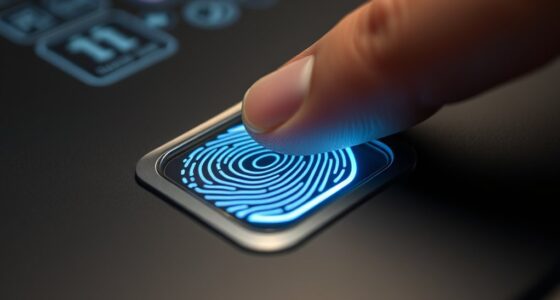
In the privacy war between Google and Apple, Apple currently leads by prioritizing user control and minimizing data collection, offering features like App Tracking Transparency to restrict tracking. Google, on the other hand, relies heavily on data for personalized ads and seamless services, which raises privacy concerns. As the battle intensifies, your choices matter. To understand who’s really winning and how these strategies impact your digital life, keep exploring the details behind their approaches.
Key Takeaways
- Apple prioritizes minimal data collection and user control, emphasizing privacy as a core value.
- Google relies on extensive data tracking to personalize services and maximize advertising revenue.
- Apple’s privacy features, like App Tracking Transparency, restrict cross-platform user tracking.
- Google’s ecosystem offers seamless, personalized experiences at the expense of more invasive data collection.
- The ongoing privacy debate reflects each company’s contrasting strategies and user trust priorities.

Have you ever wondered how Google and Apple shape the tech world through their fierce rivalry? Both giants have distinct approaches to privacy, but their strategies around data collection and user tracking reveal much about their priorities. Google, known for its advertising empire, relies heavily on data collection to personalize ads and improve user experience. Every search, click, and interaction feeds into a vast ecosystem designed to track your activity across various services. This user tracking allows Google to build detailed profiles, which they monetize through targeted advertising. While this makes their services highly tailored, it also raises questions about privacy and how much of your personal data is being harvested behind the scenes.
On the other hand, Apple positions itself as the champion of user privacy. From the outset, they’ve emphasized minimal data collection and user control. Instead of tracking users across apps and services, Apple focuses on local data processing on your device. They implement features like App Tracking Transparency, which prompts you to allow or deny tracking permissions, giving you more say over your data. Apple’s approach limits the amount of user tracking that happens in the background, reducing the scope for invasive data collection. They design their ecosystem to prioritize privacy, making it harder for third parties to access your personal information without explicit consent. This strategy resonates with users who value control over their data and are wary of being constantly monitored.
However, this difference in philosophy impacts the user experience profoundly. Google’s data collection allows for highly personalized services—search results that seem to read your mind, tailored recommendations, and seamless integration across their platform. But it comes at the cost of detailed user tracking, which some see as an invasion of privacy. Meanwhile, Apple’s privacy-first approach might mean fewer personalized services but offers peace of mind that your data isn’t being sold or exploited. They’ve introduced features like privacy labels and app privacy reports, making it clearer what data apps collect, reinforcing their stance on transparency. Additionally, the use of vetted wave and wind can enhance privacy by providing environmentally friendly energy sources for data centers and device manufacturing, aligning with ethical standards.
Ultimately, your choice between these companies depends on your comfort level with data collection and user tracking. If you prioritize personalized experiences and don’t mind sharing some data, Google’s model might appeal more. But if you’re wary of being constantly watched and prefer more control over your information, Apple’s privacy measures will seem more appealing. Each company’s approach reflects their core values and business models, defining their role in the ongoing privacy war. As the debate continues, understanding how these giants handle your data helps you make informed decisions about the digital world you navigate every day.

No Subscription Real-Time Vehicle Tracker with Magnetic Mount, Compatible with Apple Find My (iOS Only) No Monthly Fee Required
Track Updates: Track your vehicle via Apple Find My (iOS Only).
As an affiliate, we earn on qualifying purchases.
As an affiliate, we earn on qualifying purchases.
Frequently Asked Questions
How Do Google and Apple Handle User Data During Law Enforcement Requests?
When law enforcement requests user data, Google and Apple handle it differently. Google typically cooperates by complying quickly, sharing user data if legally required and feasible, but also endeavors to protect user privacy through transparency reports. Apple, on the other hand, emphasizes user privacy by limiting data sharing and resisting requests that compromise security. Both companies balance user data handling with law enforcement cooperation, but Apple leans more toward safeguarding privacy.
What Are the Recent Updates to Each Company’s Privacy Policies?
You’ll find that recent privacy policy updates show Apple now emphasizes user data transparency more than ever, giving you clearer controls over your information. Google has introduced new features aimed at increasing transparency, but critics say they still lag behind Apple’s privacy commitments. These updates reflect each company’s approach to protecting your user data, so staying informed helps you make better decisions about your digital privacy.
How Transparent Are Google and Apple About Data Breaches?
You’ll find that both Google and Apple are somewhat transparent about data breach disclosures, but Apple tends to be more proactive. They update their privacy policies regularly, emphasizing transparency about data breach incidents, and notify users promptly. Google’s approach is less consistent, often delayed in reporting breaches. While both companies aim to improve data breach transparency, Apple’s updates and communication generally provide clearer, more timely information about security issues.
Do Google and Apple Share User Data With Third-Party Advertisers?
Google and Apple both share user data with third-party advertisers, but they approach it differently. Google often allows third-party sharing through ad networks, while Apple emphasizes data anonymization to protect your privacy. Apple limits third-party access and uses data anonymization techniques to reduce privacy risks. However, if you use Google services, be aware that your data might be shared more broadly for targeted advertising, despite efforts at data anonymization.
Which Company Has Faced More Privacy-Related Legal Challenges Recently?
You should know that Google has faced more recent privacy-related legal challenges, with over 20 data breach incidents reported last year. Despite implementing stricter user consent policies, the company continues to grapple with lawsuits over data privacy. Apple, on the other hand, has maintained a cleaner record, though it isn’t immune. This statistic highlights how Google’s frequent challenges reflect ongoing concerns about privacy practices and user trust.

Ferilinso 3 Pack Privacy Screen Protector for Google Pixel 9, 9H Military-Grade Shatterproof Tempered Glass, Easy installation, Fingerprint Compatible, Case Friendly, Camera Lens Protector
Please Note: After installing the protector, you need to Re-Record Fingerprints[Very important][Very important]. In this way, you will…
As an affiliate, we earn on qualifying purchases.
As an affiliate, we earn on qualifying purchases.
Conclusion
In this battle of tech giants, remember that actions speak louder than words. While Google pushes for data-driven convenience, Apple emphasizes user privacy. The truth is, only time will tell who truly wins the privacy war. Keep your eyes open and stay informed—after all, a watchful eye is the best defense. As the saying goes, “The proof of the pudding is in the eating,” so stay vigilant and choose what aligns best with your privacy needs.

Punkt. MC02 Smartphone – Unlocked Cell Phone with Built-in VPN for Digital Security & Data Privacy Software, 4K Video & 64 MP Camera, 5G & 4G LTE, 128GB, WiFi, Bluetooth – Black
Unmatched Security: The MC02 isn't just a smartphone; it's your digital guardian. Unlike other smartphones that sell your…
As an affiliate, we earn on qualifying purchases.
As an affiliate, we earn on qualifying purchases.
Spy Associates Ultrasonic Privacy Protector – Portable Acoustic Masking Device, Voice Privacy Tool for Secure Conversations in Meetings, Offices, Cars & Travel
ULTRASONIC SPEECH PRIVACY: Uses ultrasonic acoustic output (above 25 kHz, inaudible to humans) to help protect speech privacy…
As an affiliate, we earn on qualifying purchases.
As an affiliate, we earn on qualifying purchases.