TL;DR

Get workout gear delivered free with Prime
- Fast, free delivery on millions of items
- Prime Video, Amazon Music and more included
- Member-only deals all year
Fit&Well published a yoga therapist’s seven-part seated movement routine aimed at older adults and people who prefer chair-based exercise. The report describes gentle movements and adaptation options, but does not provide clinical evidence that the routine improves health or fitness.
Fit&Well has published a seven-part seated movement routine recommended by a yoga therapist who works with older adults, including people with Parkinson’s disease, other movement disorders and chronic health conditions. The sequence uses a sturdy chair and gentle movements, with guidance to stay within each person’s own range and capacity.
The therapist describes chair-based yoga as an option for people who do not have the mobility for floor-based movement, as well as those who feel more comfortable exercising from a chair. The routine begins with a minute of settling: sit toward the back of the chair with feet flat on the floor, hands on the lap, and attention on the breath.
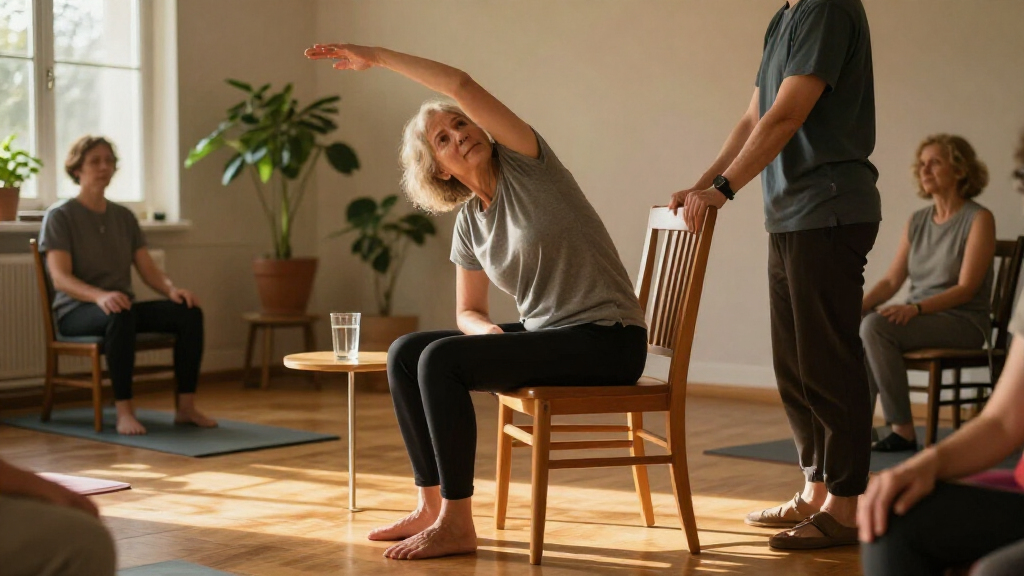
The remaining movements are an arm sweep into a prayer position, seated torso twists, single- and double-arm raises, side bends, seated cat-cow movements and a forward fold. The report generally suggests three to five repetitions, with twists and side bends performed three times on each side. It links the movements to breathing, such as inhaling while lifting the arms and exhaling while lowering them.
Several instructions give alternatives for comfort or support. During a side bend, a person can hold the chair rather than extend an arm down; during the forward fold, hands can stay on the knees. The therapist says participants should explore accessible movement rather than try to achieve a particular pose. The report specifies enough space to raise the arms and a sturdy chair, but gives no formal screening process or individual exercise prescription.
A Seated Option for Gentle Movement
The routine is presented as an option for readers who find floor-based exercise difficult or prefer to remain seated. It consists of small movements that can be modified, and uses a chair for support during the sequence.
The therapist says the practice combines stretching muscles and mobilizing joints with mindful attention to breathing. They also report that participants in their groups can feel calmer and leave feeling rested and uplifted. These are the therapist’s observations, not measured results from a study presented in the report. No research findings, participant numbers or comparisons with other exercise programs are included, so the article does not establish how much the sequence changes strength, mobility or health outcomes.
Products Worth Considering

Garmin Venu® 3 Premium Fitness Smartwatch 45mm Black

Blueair Blue Pure 511i Max Smart Air Purifier

Garmin Forerunner 55 GPS Running Smartwatch, Black
As an affiliate, we earn on qualifying purchases.
How the Seven Moves Are Structured
The sequence moves from settling into a chair to larger upper-body movements, then returns to forward and rounded positions. In the arm arc, the participant sweeps both arms overhead and brings the palms together before lowering the hands to the chest. Seated twists turn the torso and head to each side, returning to center between turns.
For the arm raises, participants lift one arm at a time before completing a double-arm raise. The side bends are done first on one side and then the other. Cat-cow alternates between lifting the chest and rounding the back, while the final forward fold pairs an overhead reach with a hinge of the upper body over the legs. The report’s instructions repeatedly make looking upward optional and offer chair-supported modifications.
““I encourage everyone to move within the range and capacity of their body—there’s no particular shape or position to achieve.””
— The yoga therapist quoted in Fit&Well
Evidence and Individual Suitability
The supplied report does not identify a study testing this particular sequence, quantify its effects or state how often readers should do it. It also does not explain whether the exercises are suitable for every person with Parkinson’s disease, another movement disorder, chronic illness, balance concerns or pain. The therapist’s experience working with older adults provides the basis for the recommendations, but the material does not name the therapist or provide a clinical review of each movement.
Readers’ mobility, comfort and support needs can differ. The report advises working within an individual range and provides some modifications, but it does not specify what to do if a movement causes pain, dizziness or other symptoms. People with health conditions or concerns about exercise suitability may wish to ask a qualified health professional for individual guidance before trying the sequence.
Trying the Routine Safely
The report does not announce a follow-up, new program or planned evaluation. Its immediate next step for readers is to follow the described sequence using a sturdy chair and clear space, while adapting or skipping movements that do not feel comfortable. The instructions suggest beginning with the short settling exercise and using the chair-supported alternatives for bends and folds when needed.
Anyone uncertain about whether the movements suit their circumstances can seek advice from a clinician or a qualified exercise professional familiar with their needs. The source does not set out a clinical monitoring plan or claim that the routine replaces other care or exercise guidance.
Key Questions
What exercises are included in the chair routine?
The seven parts are a settling exercise, an arm arc into prayer, seated twists, single- and double-arm raises, side bends, cat-cow and a forward fold. Most movements are repeated three to five times, with twists and bends done on both sides.
Who is the routine intended for?
The therapist recommends chair-based yoga for people who have difficulty with floor-based movement or feel more comfortable exercising while seated. They also describe working with older adults, including people with Parkinson’s disease, other movement disorders and chronic health conditions. The report does not say the sequence is suitable for everyone in those groups.
What equipment and space are needed?
The report calls for a sturdy chair and enough clear space to raise the arms comfortably. It does not list other equipment.
Are the exercises proven to improve health?
The report shares a therapist’s recommendations and personal observations, but provides no clinical study or measured outcomes for this specific sequence. It does not establish that the exercises improve a particular health condition.
How can someone adapt a movement?
The report suggests holding the side of the chair during a side bend for extra support and placing the hands on the knees during a forward fold. More broadly, the therapist advises moving only within a person’s own range and capacity.
Source: fitandwell.com