TL;DR

Get workout gear delivered free with Prime
- Fast, free delivery on millions of items
- Prime Video, Amazon Music and more included
- Member-only deals all year
A Fit&Well report describes three coordination exercises a trainer uses with older adults: opposite-arm-and-knee raises, side step-outs with an opposite-arm reach, and ball throws and catches. The trainer says the movements can be adapted for seated or standing practice; the report cites a 2019 review on balance and coordination exercises, but provides no new trial results or evidence that the routines extend lifespan.
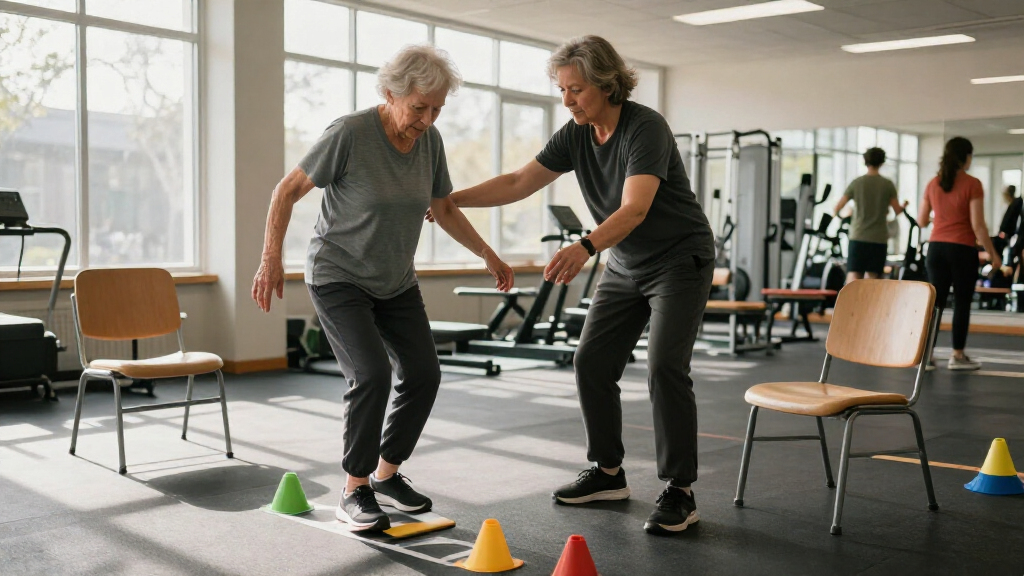
A trainer who works with older adults has described three coordination exercises used in classes and personal training: opposite-arm-and-knee raises, side step-outs with an opposite-arm reach, and ball throws and catches. The Fit&Well report says the exercises can be modified for seated practice, making the advice relevant to readers looking for movement options that can be adjusted to their mobility.
The trainer says coordination work is included alongside chair-based yoga and personal training. The stated aim is to practise the mind-to-muscle connection and movements that require the arms and legs to work together. The trainer says clients practise to support confidence and control during everyday tasks, such as moving around other people or handling several activities at home. These are the trainer’s descriptions of the purpose of the sessions, not measured outcomes from a new study.
The first exercise is a knee raise with the opposite arm. Standing with feet hip-width apart, a participant raises one knee while bringing the other arm forward at shoulder height, then alternates sides. The report suggests five or six repetitions per side and advises moving slowly and keeping the torso upright. For a seated version, participants can march in place and lift the opposite arm with each knee raise.
The second movement pairs a side step-out and opposite-arm reach. From standing, a participant steps sideways and reaches the other arm forward; a shallow side lunge is optional. The seated alternative uses a side step-out with the opposite arm opening to the side. The third exercise uses a ball: standing near a wall, a participant balances on one foot and underhand-throws the ball lightly against the wall before catching it. The report recommends five to 10 throws and says the task can be made easier by standing on both feet or sitting, using one or two hands, or choosing a different ball size.
Coordination in Everyday Movement
The report’s practical point is that coordination practice does not have to mean complex or high-impact exercise. The three examples combine ordinary actions—marching, reaching, stepping and catching—in ways that ask a person to coordinate limbs or respond to a moving object. Seated alternatives are offered for people who cannot or do not want to perform the standing versions, while standing variations can add a balance challenge for those able to do them safely.
The trainer links this work to confidence and agility in daily life. The report also cites a 2019 review that found balance and coordination exercises in older adults can improve measures of spatial awareness, postural control and stability. That is a narrower claim than proving the exercises prevent falls, preserve independence or increase lifespan. The article presents a trainer’s programme and selected research context; it does not report a new clinical test of these three routines.
soft lightweight exercise ball for seniors hand eye coordination
As an affiliate, we earn on qualifying purchases.
As an affiliate, we earn on qualifying purchases.
How the Exercises Are Adapted
The report contrasts coordination work with strength training, saying strength exercise is not the only kind of activity that may support ageing well. Its trainer says coordination becomes a more intentional focus in later life, whereas combining limb movements may feel automatic when people are younger. This is the trainer’s rationale for including the exercises, rather than a claim that coordination inevitably declines in every older adult.
The options range from seated marching to standing balance work. For the first two exercises, the instructions keep the movements simple and repeatable, with five or six repetitions on each side. The ball drill adds a reaction element, with the report suggesting that the throw can be directed differently to vary the challenge. It gives no formal progression plan or testing standard, and it does not specify how often a person should do the routines.
“I always incorporate coordination training into my chair-based yoga classes and personal training sessions with older adults.”
— The trainer quoted in Fit&Well
non-slip exercise mat for balance exercises seniors
As an affiliate, we earn on qualifying purchases.
As an affiliate, we earn on qualifying purchases.
Evidence and Safety Details
The supplied report does not identify the trainer by name, provide the publication date, or give details such as the number of clients who use the exercises. It cites a 2019 review but does not name the review or provide its methods, participant numbers, or effect sizes. The report therefore does not establish how much these particular exercises change coordination, balance or day-to-day function, nor whether they affect longevity.
It also does not set out screening guidance for readers with pain, balance concerns, or health conditions that affect movement. Standing on one leg and throwing a ball can create a fall risk for some people. Readers who are unsure whether a movement is suitable can seek guidance from a qualified health or exercise professional and use a stable support or seated variation as appropriate. The article does not provide a personalised assessment.
stable chair with arms for seated exercises seniors
As an affiliate, we earn on qualifying purchases.
As an affiliate, we earn on qualifying purchases.
Applying the Advice Safely
The report offers no announced follow-up study, new programme or timetable for further results. Its immediate guidance is a set of repeatable exercises with lower-challenge alternatives: seated marching and reaches, seated side step-outs, or throwing and catching while seated or standing on both feet. Readers who try them can begin with the version that feels controlled and avoid adding a balance challenge before they are comfortable with the basic movement.
What happens next for the evidence depends on further research that tests these specific routines and reports the participants, frequency, outcomes and duration. Until then, the Fit&Well piece is best read as practical trainer guidance supported by a cited review of broader balance and coordination exercises, not as proof that this three-exercise set will produce a particular health outcome.
Key Questions
Which coordination exercises does the report recommend?
It describes opposite-arm-and-knee raises, side step-outs paired with an opposite-arm reach, and ball throws and catches. Each movement can be adjusted to suit the participant.
Can the exercises be done while seated?
Yes. The report gives seated versions of all three: marching with an opposite-arm lift, a side step-out with an arm opening to the side, and a ball throw and catch while sitting.
Does the report show these exercises extend lifespan?
No. It describes a trainer’s practice and cites a 2019 review on balance and coordination exercises. It does not report evidence that these three specific movements extend lifespan.
How many repetitions are suggested?
The report suggests five or six repetitions per side for the knee raise and side step-out, and five to 10 throws and catches for the ball exercise.
What if standing balance exercises feel unsafe?
The report suggests seated versions or doing the ball exercise while standing on both feet. People uncertain about a movement’s suitability can ask a qualified health or exercise professional for guidance.
Source: rss
Halloween Picks
halloween
As an affiliate, we earn on qualifying purchases.