
TL;DR

Get workout gear delivered free with Prime
- Fast, free delivery on millions of items
- Prime Video, Amazon Music and more included
- Member-only deals all year
Fit&Well published a five-move, squat-free Pilates leg sequence from instructor Lottie Anderson, designed to be done at home. Each exercise is prescribed for two rounds of 8–12 repetitions per side; ankle weights are optional, and the report does not provide evidence that the sequence suits every person or condition.
Fit&Well has published a five-move Pilates leg workout that can be done at home without squats, offering an alternative for people who find the exercise uncomfortable or difficult. Pilates instructor Lottie Anderson, founder of London studio Bondi Rise, recommends two rounds of 8–12 repetitions on each side for every move; ankle weights are optional.
The sequence uses a mat and begins on hands and knees. Its first three exercises are the horse kick, which lifts a straight leg behind the body; the rainbow kick, which sweeps a raised leg from side to side; and the hamstring extension, which alternates between bending and straightening the leg. The source says to keep the hips stable during the kicks and, for the hamstring move, keep the thigh lifted if possible.
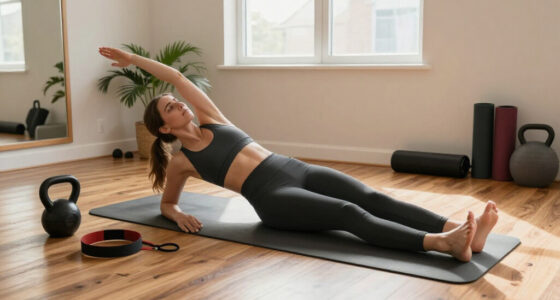
The final two exercises use a kneeling side-plank position. In the kneeling lift and lower, the top leg rises and lowers with the toes pointed. In the kneeling side kick, the leg extends in line with the hips, bends toward the chest and straightens again. Anderson’s instructions call for the waist to stay lifted and the hips to face forward. The report gives the same prescription for all five movements: two rounds of 8–12 repetitions per side.
Anderson uses ankle weights to increase the challenge in her demonstrations, but the article says they are not required. It describes the horse kick as working the glutes and hamstrings while the core helps stabilize the body. The source does not present clinical testing or comparative results for the routine; it is a reported workout recommendation, not a study establishing a particular outcome.
A Squat-Free Lower-Body Option
The routine gives readers a structured alternative to a familiar lower-body exercise. Fit&Well notes that tight hamstrings, limited ankle mobility, balance difficulties or tender joints can make squatting uncomfortable for some people. A sequence with no squats may be more approachable for them, although it still includes kneeling and supported side-plank positions that may not suit everyone.
Anderson frames leg strength around everyday tasks, including getting up and down, carrying a child and climbing stairs. She says the glutes help stabilize the pelvis and support movement around the lower back and knees. Those statements are her explanation of why she values lower-body training; the article does not establish that this specific five-move workout prevents pain or treats an existing condition.
Products Worth Considering

Bowflex SelectTech 840 Adjustable Kettlebell

BowFlex Results Series SelectTech Adjustable Dumbbells (Pair)

Withings BPM Connect Wi-Fi and Bluetooth Blood Pressure Monitor
As an affiliate, we earn on qualifying purchases.
How Anderson Structures the Sequence
The exercises are presented as a home routine, with each side trained separately. The first three movements start on all fours and focus on moving one leg while keeping the torso and hips controlled. The remaining two rotate the body into a kneeling side position, adding a different balance and support demand. No equipment is listed as necessary beyond a mat-like surface, and ankle weights are optional.
Anderson connects the workout to functional strength. “Your legs carry you through everything,” she says, describing everyday activities such as getting down to play with her son, lifting him into a car seat and carrying him upstairs. She also says glutes support pelvic stability and posture. These are attributed comments from the instructor, rather than findings independently measured in the report.
“Your legs carry you through everything.”
— Lottie Anderson, Pilates instructor and founder of Bondi Rise
Who Can Safely Do These Moves
The report does not say that the workout has been tested in a clinical study, nor does it compare its effects with squats or other strength exercises. It also does not specify how long the full sequence takes, how often readers should repeat it, or how to modify each move for injury, pregnancy, mobility limitations or pain. While the article identifies reasons some people may struggle with squats, kneeling and side-plank positions can also be challenging.
Readers should stop if a movement causes pain and choose a comfortable range rather than forcing the position. Anyone with an injury, a relevant health condition or uncertainty about exercise should seek guidance from a qualified health professional or instructor. The source does not make claims that the routine treats joint problems or prevents back or knee pain.
Use the Repetition Guide Carefully
The next step for readers interested in trying the routine is to follow the instructor’s sequence at a manageable pace: two rounds of 8–12 repetitions per side for each exercise, without ankle weights at first if added resistance feels unsuitable. The source gives no follow-up schedule or progression plan, so it does not establish how often to perform the workout or when to increase difficulty.
Further guidance would be needed to determine suitable modifications for people who cannot kneel or comfortably support themselves on one arm. Until then, the routine should be treated as one suggested home workout, not a universal substitute for individualized instruction or medical advice.
Key Questions
What are the five exercises in the routine?
The sequence is the horse kick, rainbow kick, hamstring extension, kneeling lift and lower, and kneeling side kick.
How many repetitions does the report recommend?
Fit&Well lists two rounds of 8–12 repetitions on each side for each movement.
Do you need ankle weights?
No. The report says Anderson uses ankle weights to make the exercises harder, but they are optional.
Is this workout suitable for everyone who avoids squats?
The source does not establish that it suits everyone. Several moves require kneeling or supporting the body in a side position, so people with pain, injuries or mobility concerns may need professional guidance or alternatives.
Source: fitandwell.com