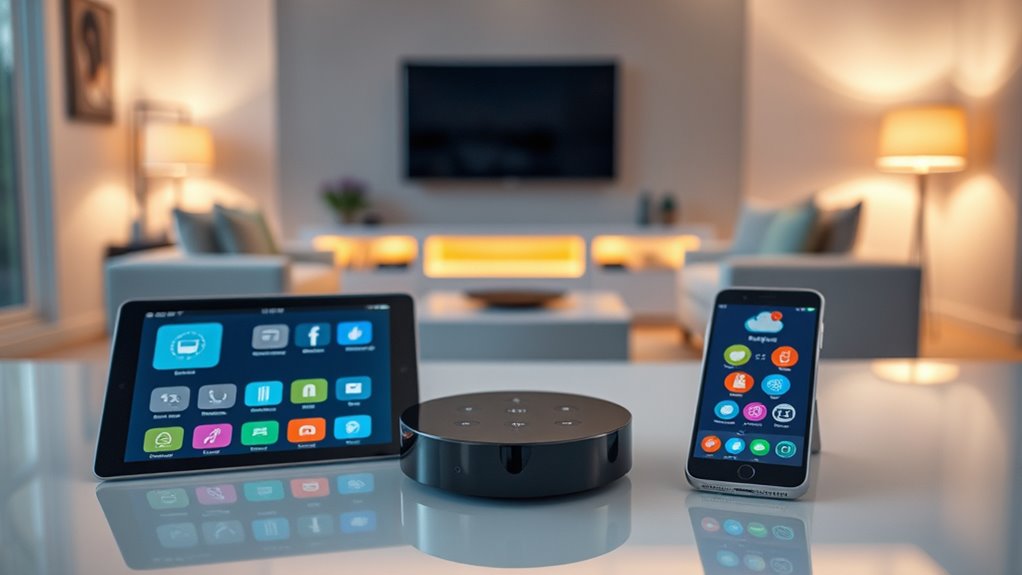

A smart home hub usually offers better control and voice command support over multiple devices because it acts as a central platform integrating various brands through standards like Zigbee or Z-Wave. It simplifies management by reducing the need to juggle multiple apps, making your smart home more seamless and efficient. If you’d like to see how a hub can streamline your setup and improve your experience, there’s more to discover below.
Open a free Amazon Business account
Business pricing, bulk buying and tax-exempt orders.
As an affiliate, we earn on qualifying purchases.
Key Takeaways
- Hubs offer centralized voice control and device management, simplifying smart home operation across multiple brands.
- Individual apps provide tailored controls but may require managing multiple platforms, increasing complexity.
- Hubs support standards like Zigbee and Z-Wave, enabling broad device compatibility and interoperability.
- Using a hub streamlines automation and reduces app-switching, enhancing user experience and convenience.
- Choosing between them depends on your need for integrated control versus brand-specific customization.

Are you wondering whether to rely on a smart home hub or individual apps to control your devices? It’s a common dilemma, and your choice can critically affect how smoothly your smart home functions. One of the key factors to consider is voice control. With a smart home hub, voice commands become more seamless because the hub acts as a central processor, allowing you to control multiple devices through a single voice assistant like Alexa, Google Assistant, or Siri. This setup makes managing your smart home feel intuitive—you simply speak, and your devices respond. On the other hand, if you prefer controlling devices individually via their dedicated apps, voice control might require using each app separately or jumping between platforms, which can be less convenient.
Device compatibility is another vital aspect. A smart home hub typically supports a wide range of devices from different brands, provided they adhere to common standards like Zigbee or Z-Wave. This broad compatibility means you can integrate smart bulbs, locks, thermostats, and sensors from various manufacturers into one unified system. It simplifies managing your devices because you don’t need to juggle multiple apps, each with its own interface. Conversely, individual apps are often limited to specific brands or ecosystems. While this might mean better optimization within each app, it can create challenges if you’re mixing devices from different brands. You might end up with several apps open, each controlling a subset of your smart home, which can complicate things rather than streamline them. Additionally, device interoperability is a crucial factor because it determines how well different devices can work together within your chosen setup.
smart home hub with Zigbee and Z-Wave support
As an affiliate, we earn on qualifying purchases.
As an affiliate, we earn on qualifying purchases.
Frequently Asked Questions
Can I Use a Smart Home Hub With Non-Compatible Devices?
You generally can’t use a smart home hub with non-compatible devices because of device compatibility issues. Hub limitations mean it only works with devices that support its protocols or integrations. If your devices aren’t compatible, the hub won’t be able to control them properly. To guarantee smooth operation, check the compatibility list before buying a hub, or consider using individual apps that work directly with your devices for better flexibility.
Which Option Offers Better Privacy and Security?
A smart home hub generally offers better privacy and security because it centralizes control, reducing potential vulnerabilities from multiple apps. You benefit from stronger encryption standards and consistent data privacy protocols, which protect your information more effectively. With a hub, you can better monitor access and updates, ensuring your smart devices stay secure. Overall, a hub provides a more controlled environment, helping you safeguard your smart home from cyber threats.
How Do Updates Differ Between Hubs and Individual Apps?
Updates for smart home hubs tend to be less frequent but more all-encompassing, ensuring firmware consistency across all connected devices. In contrast, individual apps often receive updates more frequently, providing quicker bug fixes and feature enhancements. You’ll notice that hub updates focus on system stability, while app updates prioritize user interface improvements. This difference means your hub may need less frequent attention, but apps keep evolving faster to meet your changing needs.
Are There Cost Differences Between Using a Hub or Multiple Apps?
You might find that using a smart home hub costs less upfront, with about 30% fewer devices needing separate apps, reducing overall expenses. Hubs often improve device compatibility and streamline app customization, making setup easier. Individual apps can add up in costs, especially if you buy multiple, whereas a hub centralizes control. So, if budget is a concern, a hub could be a more economical choice for managing your smart devices effectively.
What Is the Learning Curve for Beginners With Each Option?
You’ll find that a smart home hub offers a more user-friendly setup, making it easier for beginners to get started without much technical complexity. With individual apps, you might face a steeper learning curve since each app can have different interfaces and requirements. Overall, a hub simplifies initial setup and daily use, while individual apps may require more time and patience to master.
best smart home hub for voice control
As an affiliate, we earn on qualifying purchases.
As an affiliate, we earn on qualifying purchases.
Conclusion
Choosing between a smart home hub and individual apps is like selecting a compass or a map. The hub acts as your guiding star, uniting all devices under one sky, simplifying your journey. Individual apps, like stars scattered across the night, offer independence but can be harder to navigate. Ultimately, whether you prefer the steady beacon of a hub or the freedom of starry apps, your choice shapes your home’s symphony—making it truly yours.
As an affiliate, we earn on qualifying purchases.
smart home device compatibility hub
As an affiliate, we earn on qualifying purchases.
As an affiliate, we earn on qualifying purchases.
Fall yard work Picks
leaf blowers
As an affiliate, we earn on qualifying purchases.