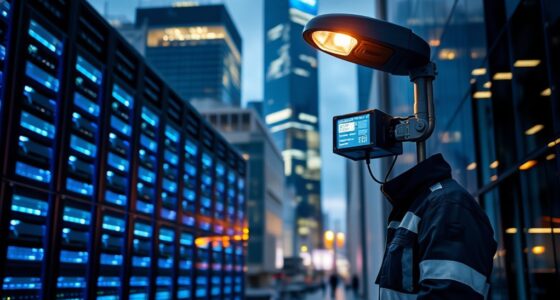

Li-Fi uses visible light from LED bulbs to transmit internet data, offering a secure and interference-free alternative to Wi-Fi. Since light can’t pass through walls, your connection stays confined to a room, reducing outside access risks. However, it needs a direct line of sight and can be blocked by objects, limiting coverage and mobility. While promising for specific environments, ongoing improvements are making Li-Fi more practical—if you’re curious about how this technology can change your connectivity options, stay tuned for more details.
Listen free for 30 days with Audible
Thousands of audiobooks and originals — cancel anytime.
As an affiliate, we earn on qualifying purchases.
Key Takeaways
- Li-Fi transmits data using visible light from LED bulbs, offering an alternative to radio-based Wi-Fi.
- Its confinement within rooms enhances security but limits outside access and mobility.
- Li-Fi requires direct line of sight and is easily blocked, restricting coverage and practicality in dynamic environments.
- Ongoing advancements aim to improve hardware, signal strength, and security, making Li-Fi more reliable over time.
- Currently, Li-Fi is a supplement for specific secure settings and unlikely to fully replace Wi-Fi soon.
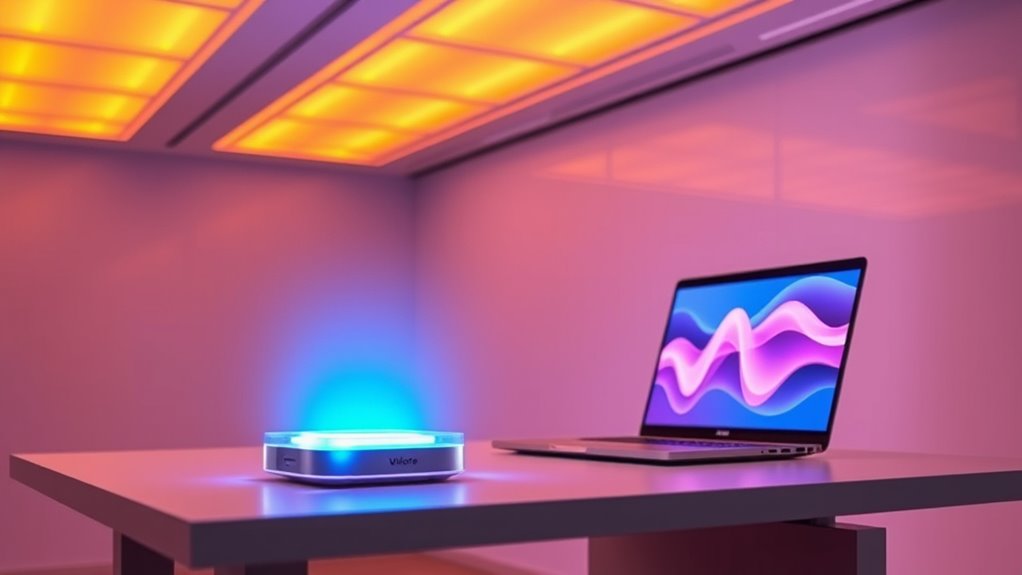
As wireless technology continues to evolve, Li-Fi—short for Light Fidelity—emerges as a promising alternative to traditional Wi-Fi. Unlike Wi-Fi, which relies on radio waves, Li-Fi uses visible light from LED bulbs to transmit data. This innovative approach offers exciting possibilities, especially in environments where radio frequency interference is an issue. But before you get too excited about replacing Wi-Fi with Li-Fi, it’s important to consider some challenges, notably security concerns and technological limitations.
One of the main security concerns with Li-Fi relates to how the light signals operate. Since light cannot pass through walls, the data transmission is confined within a room or a specific space. This might sound like an advantage, as it naturally limits outside access, but it also introduces new vulnerabilities. If someone is inside the same space, they could potentially intercept the light signals with specialized equipment, raising questions about data privacy. Additionally, because Li-Fi relies on visible light, any interruption—like someone covering the light source or turning off the lights—can cause data loss or communication disruptions. These issues make it critical to develop robust encryption methods and fallback systems to ensure data remains secure and transmission remains reliable.
Technological limitations also pose hurdles to widespread Li-Fi adoption. For starters, the technology requires a direct line of sight between the light source and your device. Unlike Wi-Fi, which can penetrate walls and obstacles, Li-Fi signals are easily blocked by objects, furniture, or even people moving around. This limits mobility and makes it less practical for dynamic environments. Furthermore, current Li-Fi systems suffer from limited range, typically only functioning within a few meters, which constrains its use in larger spaces. The hardware needed, such as specialized LED bulbs and photodetectors, is still evolving and can be costly or incompatible with existing infrastructure. These factors mean that, at least for now, Li-Fi is better suited for specific applications—like secure office environments or industrial settings—rather than replacing Wi-Fi everywhere.
Despite these hurdles, researchers are actively working to improve Li-Fi’s capabilities. Advances in LED technology, better modulation techniques, and enhanced security protocols are gradually overcoming some of the current limitations. For example, integrating adaptive beamforming techniques can help optimize signal strength and coverage. Still, for everyday users, the promise of seamless, fast, and secure internet via light remains a work in progress. So, while Li-Fi may eventually complement or even supplement Wi-Fi in particular scenarios, it’s unlikely to completely replace traditional wireless networks in the near future. You should stay informed about these developments, as the landscape of wireless communication is changing rapidly—and Li-Fi is certainly a part of that evolution.
Li-Fi LED light internet adapter
As an affiliate, we earn on qualifying purchases.
As an affiliate, we earn on qualifying purchases.
Frequently Asked Questions
How Does Li-Fi Perform in Outdoor Environments?
Li-Fi’s outdoor performance depends on light intensity and obstacles. You might find it effective in open areas with strong sunlight, but outdoor obstacles like trees, buildings, or moving objects can block the light signal, reducing speed and reliability. To maximize its use outdoors, guarantee a clear line of sight and adequate light levels. However, in shaded or cluttered environments, Wi-Fi remains more consistent and practical.
What Are the Security Benefits of Li-Fi Over Wi-Fi?
Imagine your data locked behind a luminous shield—li-fi’s security benefits become clear. You’re protected by advanced encryption protocols that safeguard your information from cyber threats. Unlike Wi-Fi, physical barriers like walls can block or contain signals, making unauthorized access nearly impossible. With li-fi, you gain a safer environment where your sensitive data stays within your control, shining brightly in the dark without the risk of hacking or intrusion.
Can Li-Fi Be Used Alongside Existing Wireless Networks?
Yes, you can use Li-Fi alongside existing wireless networks, but you need to manage interference and address compatibility challenges. Li-Fi works best in specific environments where light signals won’t interfere with Wi-Fi. To guarantee smooth operation, you might need to set up interference management strategies, like dedicated channels or physical barriers. While integration is possible, understanding these technical aspects helps you maximize performance without disruptions.
What Is the Cost Comparison Between Li-Fi and Wi-Fi Deployment?
Think of Wi-Fi as a trusty old car and Li-Fi as a sleek new electric vehicle. The cost comparison shows Li-Fi often has higher upfront expenses due to specialized LED hardware and installation, making deployment challenges steeper. However, over time, Li-Fi’s efficiency and security could save you money. You’ll need to weigh initial costs against long-term benefits, especially if you’re ready to embrace the future of lightning-fast, light-based internet.
How Does Li-Fi Handle Data Interference From Other Light Sources?
Li-Fi handles light interference and signal disruption better than you might think because it uses visible light to transmit data, which isn’t affected by radio frequency issues. When other light sources cause interference, the system adjusts by switching channels or increasing signal strength, ensuring a stable connection. This makes Li-Fi more reliable in environments with multiple light sources, reducing the chances of signal disruption and maintaining fast, consistent data transfer.
As an affiliate, we earn on qualifying purchases.
Conclusion
Imagine a world where your internet is faster, more secure, and more efficient. Picture lighting your home with Li-Fi, not just illuminating but connecting you. Envision a future where you switch seamlessly from Wi-Fi to Li-Fi, enjoying the benefits of light-based internet. Embrace the potential of Li-Fi to revolutionize your connectivity, to enhance your experiences, and to redefine how you stay connected. The choice is yours—to stick with the old or to step into the future with Li-Fi.
Li-Fi security encryption devices
As an affiliate, we earn on qualifying purchases.
As an affiliate, we earn on qualifying purchases.
As an affiliate, we earn on qualifying purchases.
Fall Picks
fall essentials
As an affiliate, we earn on qualifying purchases.