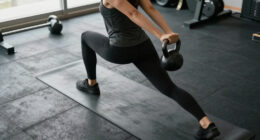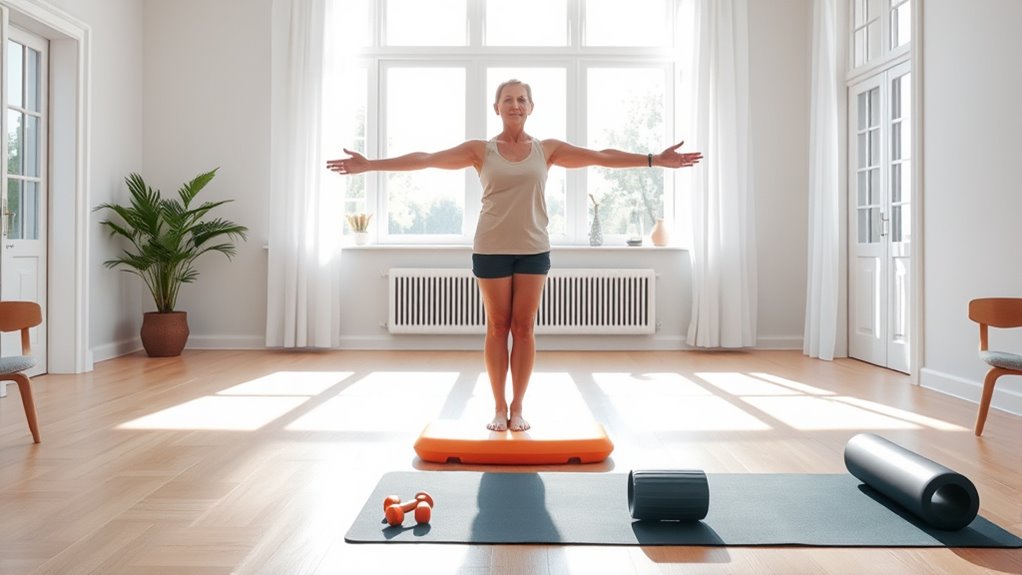

To improve your balance at home, try five simple exercises that incorporate visual cues and proprioception. Use a sturdy chair or wall as a visual reference, and challenge yourself with single-leg stands, standing on soft surfaces, or closing your eyes during activities. Focus on controlled movements and gradually increase difficulty. Consistent practice enhances stability, coordination, and confidence, helping prevent falls. Keep going to discover more effective ways to boost your balance and safety.

Get workout gear delivered free — and shop member deals
- Fast, free delivery on millions of items
- Access to Prime Big Deal Days deals on October 6–7
- Prime Video, Amazon Music and more included
Key Takeaways
- Incorporate simple exercises like single-leg stands and heel-to-toe walks to boost stability at home.
- Use visual cues such as chairs, lines, or walls to enhance spatial awareness during balance exercises.
- Challenge proprioception by practicing on soft surfaces or with eyes closed to improve body awareness.
- Gradually increase exercise difficulty by reducing support or adding arm movements for better coordination.
- Practice consistently and prioritize safety to prevent falls and strengthen overall balance and confidence.

Have you ever thought about how simple it is to improve your balance without leaving home? You don’t need fancy equipment or a gym membership—just a little space and some focus. One of the most effective ways to enhance your stability is by using visual cues. These are references in your environment that help your brain assess your position and movement, giving you immediate feedback to maintain or correct your posture. For example, placing a chair, a line on the floor, or even a wall in front of you can serve as visual cues. When you focus on these references during your exercises, you help your brain process spatial information faster, which improves your overall balance. Incorporating visual cues is simple; just choose something stable and within your line of sight, and use it as a guide during your practice.
Use visual cues like chairs or lines to boost your balance at home easily.
Alongside visual cues, proprioception exercises play a *vital* role in balance training. Proprioception refers to your body’s ability to sense its position in space, even without visual input. When you perform proprioception exercises, you’re challenging your body’s awareness of joint position and muscle tension, which helps prevent falls by improving coordination and reaction time. For example, standing on one leg or using a cushion to stand on forces your muscles and joints to work harder to keep you upright. As you progress, try closing your eyes or reducing the stability of your surface to further stimulate proprioception. These exercises don’t require any special equipment and can be done easily at home, making them highly accessible. Interestingly, incorporating exercises that mimic balance training can further enhance your stability and help prevent falls effectively.
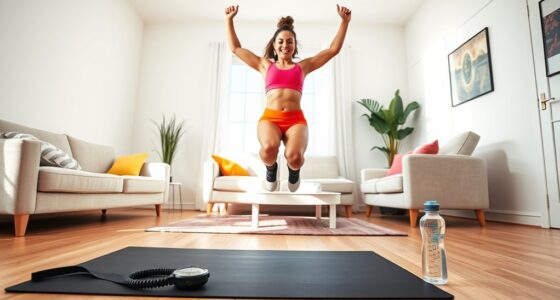
To get started, find a clear space and set up simple exercises. Use a sturdy chair or wall nearby for support as needed. Begin with standing on one leg, focusing on keeping your body steady while looking at a fixed point or visual cue in front of you. Engage your core, and breathe steadily. To enhance proprioception, try standing on a soft surface like a pillow or foam pad, which challenges your body’s balance sensors even more. As you improve, you can incorporate movements like arm raises or gentle torso twists to activate multiple muscle groups while maintaining your balance.
Consistency is key. Practice these exercises daily or several times a week, gradually increasing difficulty by reducing support or closing your eyes. Remember, the goal is to challenge your balance gradually and safely. By integrating visual cues and proprioception exercises into your routine at home, you’ll notice improvements in stability, coordination, and confidence—helping you avoid falls and stay active longer. And the best part? All of this can be done comfortably within your own living space, with minimal equipment and maximum benefits.
balance training exercises for seniors
As an affiliate, we earn on qualifying purchases.
As an affiliate, we earn on qualifying purchases.
Frequently Asked Questions
Can Balance Exercises Help With Specific Medical Conditions?
Yes, balance exercises can help with specific medical conditions by supporting medical condition management and neurological impairment support. You’ll improve stability, reduce fall risk, and enhance your overall mobility. These exercises target muscle strength and coordination, which are essential for neurological conditions like stroke or Parkinson’s. Consistent practice can boost your confidence and independence, making daily activities safer and easier as you work to manage your health effectively.
How Often Should I Do Balance Training Exercises Weekly?
Think of your balance as a delicate tightrope you walk daily. To keep it steady, aim for 2-3 weekly routines of balance exercises. Consistency is your safety net, preventing falls and strengthening stability. By dedicating a few days each week, you nurture your body’s ability to stay upright and confident. Remember, regular practice is the key to maintaining that perfect balance in your life.
Are There Any Age-Specific Balance Exercises Recommended?
Yes, age-specific routines and senior-friendly activities are recommended to enhance your balance safely. For seniors, try seated leg lifts, heel-to-toe walks, or gentle tai chi, which focus on stability and coordination. These exercises are designed to match your mobility level, reducing fall risk while strengthening muscles. Incorporate them into your routine a few times a week, and always consult a healthcare professional before starting new activities to make certain they suit your needs.
Can Balance Training Replace Physical Therapy for Fall Prevention?
Balance training at home can’t substitute clinical assessment and professional supervision for fall prevention. While exercises improve stability, a healthcare professional evaluates your specific risks and creates a tailored plan. They identify underlying issues, monitor progress, and adjust exercises as needed. Relying solely on home exercises may overlook critical health factors, so combining balance training with professional guidance ensures safer, more effective fall prevention.
What Equipment Is Necessary for Effective Home Balance Exercises?
You might be surprised how simple equipment can boost your balance. To get started, grab an exercise mat for comfort and stability, plus a couple of balance discs to challenge your core. These tools are affordable and easy to store, yet they make your exercises more effective. With just these essentials, you can create a safe, engaging space at home to improve stability and prevent falls.
As an affiliate, we earn on qualifying purchases.
Conclusion
By incorporating these simple balance exercises into your routine, you’ll not only improve stability but also enjoy the surprising benefits of better coordination and confidence. It’s funny how a few minutes a day can make such a difference—sometimes when you least expect it, your balance improves, and you feel more secure in everyday movements. So, stay consistent, have fun, and watch as these small changes lead to a more confident, fall-free you.
As an affiliate, we earn on qualifying purchases.
As an affiliate, we earn on qualifying purchases.
Halloween Picks
halloween
As an affiliate, we earn on qualifying purchases.