TL;DR

Get workout gear delivered free with Prime
- Fast, free delivery on millions of items
- Prime Video, Amazon Music and more included
- Member-only deals all year
Fit&Well recommends a weekly sequence of forward, side and curtsy lunges, with dumbbells optional, as a way to train the glutes and other lower-body muscles. Its suggested plan is six to eight repetitions per leg for each movement across two or three sets; the report does not provide comparative research showing that this frequency or routine is best for everyone.
Fit&Well has published a three-movement lunge workout that it recommends doing once a week to train the glutes and other lower-body muscles. The routine combines forward, side and curtsy lunges, with dumbbells optional, and calls for six to eight repetitions on each leg for each exercise across two or three sets.
The report presents lunges as a complement to squats, not a replacement. Its author says the different directions of movement can involve parts of the glutes that squats may not target in the same way. The article identifies the gluteus maximus, gluteus medius and gluteus minimus as the three muscles the sequence is intended to work. This is the report’s training rationale, rather than evidence from a cited comparison trial.
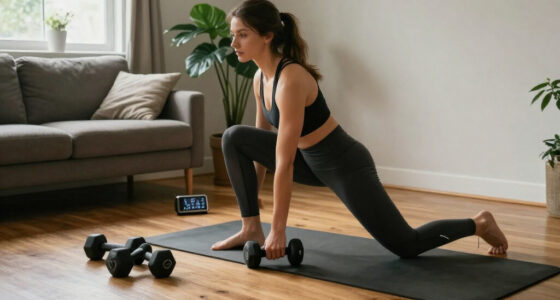
For the forward lunge, stand with feet about hip-width apart, brace the core and step forward. Bend both knees to lower, aiming for roughly 90-degree angles while keeping the front knee over the foot and the chest upright; push through the front foot to stand. For the side lunge, step out to one side, bend that knee and send the hips back while the other leg stays straight. Return by pushing through the bent leg.
The curtsy lunge completes the sequence: step one foot back and across behind the other, bend both knees, then push through the front foot to rise. The source suggests six to eight reps per side for each movement and two or three total sets. People who find alternating sides difficult can complete repetitions on one side before switching. The author recommends a bodyweight round as a warm-up before adding dumbbells, and says the weights can be held at the sides, at the shoulders or at the chest.
A Three-Direction Lower-Body Session
The workout offers a short, structured option for people who want to add directional variety to a lower-body session. Forward, lateral and crossing steps ask the legs and hips to move in different patterns. Fit&Well says the side and curtsy variations also recruit muscles and ligaments linking the core and lower spine, and may support hip and ankle mobility and stability. Those are the article’s stated benefits; they should not be read as a guarantee of improved joint health or a treatment for back problems.
The recommendation is practical rather than a formal training standard: one weekly session may fit into a broader program or be performed on its own, according to the report. The source does not establish that once a week is sufficient for every person, or that this exact routine produces a particular amount of strength or muscle growth. Results depend on factors such as experience, effort, recovery and the rest of a person’s exercise program.
Products Worth Considering

BowFlex Results Series SelectTech Adjustable Dumbbells (Pair)

Bowflex SelectTech 840 Adjustable Kettlebell

Garmin Forerunner 55 GPS Running Smartwatch, Black
As an affiliate, we earn on qualifying purchases.
How the Lunge Sequence Is Set Up
The article is written from the perspective of a Fit&Well contributor who says they regularly use the sequence and found it helpful while rehabbing after a diagnosis of a bulging disc. That is a personal account, not clinical evidence that lunges help treat a spinal condition. The routine is framed as adaptable: bodyweight is an option, and the author advises increasing or decreasing repetitions so the last few feel challenging.
For weighted versions, the source advises starting with bodyweight as a warm-up and building load gradually over sets or weeks. The exercises can be added to a weekly training program or done as a standalone short workout. No equipment brand, fixed dumbbell weight or progression schedule is specified.
““There’s another leg exercise I do to target parts of the glutes that squats don’t reach: the lunge.””
— Fit&Well report author
Evidence and Individual Suitability
The supplied report does not cite a study establishing that this exact sequence, performed once weekly, is enough to build strong glutes, nor does it compare the routine with other exercises or training frequencies. Its claims about muscle activation, mobility and joint stability are presented as the author’s rationale and experience. The source also gives no recommended dumbbell weight, rest periods or guidance on how to progress beyond increasing load gradually.
Whether the movements are suitable can vary with a person’s balance, mobility, pain and training history. The report does not provide modifications for injuries or medical conditions. Anyone with an existing back, hip, knee or ankle problem, or who experiences pain while exercising, should seek guidance from a qualified health or exercise professional before trying weighted variations.
Use the Routine With Gradual Loading
The report’s immediate recommendation is to try the three movements as part of a weekly program, beginning with a bodyweight warm-up and adding dumbbells gradually if appropriate. It does not announce a follow-up study or a scheduled update. Readers adopting the routine can monitor their form and comfort, use a stable range of motion, and adjust or stop movements that cause pain; the source gives no specific timetable for assessing progress.
Key Questions
What exercises are in the workout?
The sequence includes forward lunges, side lunges and curtsy lunges, performed on both sides.
How many repetitions and sets does Fit&Well recommend?
The report suggests six to eight repetitions per leg for each exercise and two or three sets in total.
Do I need dumbbells?
No. Fit&Well says the routine can be done with bodyweight. For weighted versions, it suggests a bodyweight round first and gradually increasing the load.
Does the report prove once-weekly lunges build glutes?
No. It offers a workout recommendation and the author’s rationale, but the supplied report cites no research establishing that this exact routine or frequency works for everyone.
What if I have a back or joint condition?
The report does not give condition-specific modifications. People with a pre-existing back, hip, knee or ankle problem should ask a qualified professional for guidance before trying the routine, especially with added weight.
Source: fitandwell.com