
TL;DR

Get workout gear delivered free — and shop member deals
- Fast, free delivery on millions of items
- Access to Prime Big Deal Days deals on October 6–7
- Prime Video, Amazon Music and more included
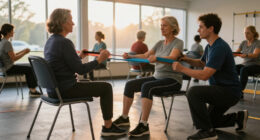
Fit&Well reported that ACE-certified trainer Margarita Severnaia recommends five basic strength exercises for women starting resistance training in their 50s. Her suggested routine begins with one set of eight repetitions per exercise, with two or three weekly sessions focused first on learning controlled movement.
Fit&Well has published a five-exercise strength routine for women beginning resistance training in their 50s, with advice from ACE-certified personal trainer Margarita Severnaia of San Diego Health and Fitness. The plan starts with one set of eight repetitions per movement and puts learning technique ahead of exercising to exhaustion.
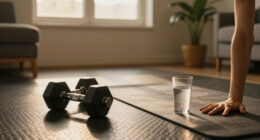
The five recommended movements are a chair squat, Romanian deadlift, supported one-arm dumbbell row, incline push-up and farmer carry. Together, they practice sitting and standing, hinging at the hips, pulling, pushing and carrying while walking. Severnaia suggests starting with two or three full-body sessions each week, with enough recovery between them.
For the first few weeks, the focus should be on coordination, confidence and controlled movement, Severnaia told Fit&Well. The workout guidance begins at one set of eight repetitions per exercise; over time, a beginner can build toward two or three sets of eight to 12 repetitions. The source lists 30 to 90 seconds of rest between several exercises and a 30-second farmer carry.
Severnaia’s form advice emphasizes using a range of motion and load that can be controlled. For example, the chair squat should end in a light touch on the chair rather than a drop, and the Romanian deadlift should hinge at the hips while keeping the weights close to the legs. The row is supported to reduce the balance demands, while the incline push-up can be made easier by using a higher stable surface.
Building Strength for Daily Tasks
The routine offers an entry point for readers who may not have used weights before. Its movements resemble common tasks such as standing from a seat, lifting objects, pushing, pulling and carrying. The progression also makes the first step more manageable: begin with a small amount of work, practice control, then add repetitions or sets as ability develops.
Severnaia says strength training can help preserve or rebuild muscle, support bone strength, balance and physical function, and make everyday activities easier. She also links midlife muscle loss and menopause-related changes in bone density with longer-term concerns such as sarcopenia, osteoporosis, falls and fractures. These are the trainer’s general health rationale for the routine; Fit&Well’s report does not present clinical trial results or claim that this particular five-move plan prevents those conditions.
The advice may be relevant to women who want to remain capable in daily life as they age, but the article’s scope is introductory exercise guidance. It does not assess an individual reader’s health, mobility or training history. People with medical conditions, pain or significant movement limitations may need advice tailored by a qualified health professional before beginning or changing an exercise routine.
How the Five Moves Fit Together
Severnaia’s plan uses familiar movement patterns rather than a long list of isolated exercises. A chair squat practices lowering and rising; the Romanian deadlift teaches a hip hinge that works the back of the thighs and other muscles along the back of the body. The trainer describes learning that hinge as a useful way to load the posterior chain without simply bending through the lower back.
The supported dumbbell row introduces a pulling movement while one hand rests on a stable surface. An incline push-up works the pushing pattern, with the support height offering a way to adjust difficulty. The farmer carry combines holding weights with walking, which Severnaia says involves grip strength, trunk control, posture and walking.
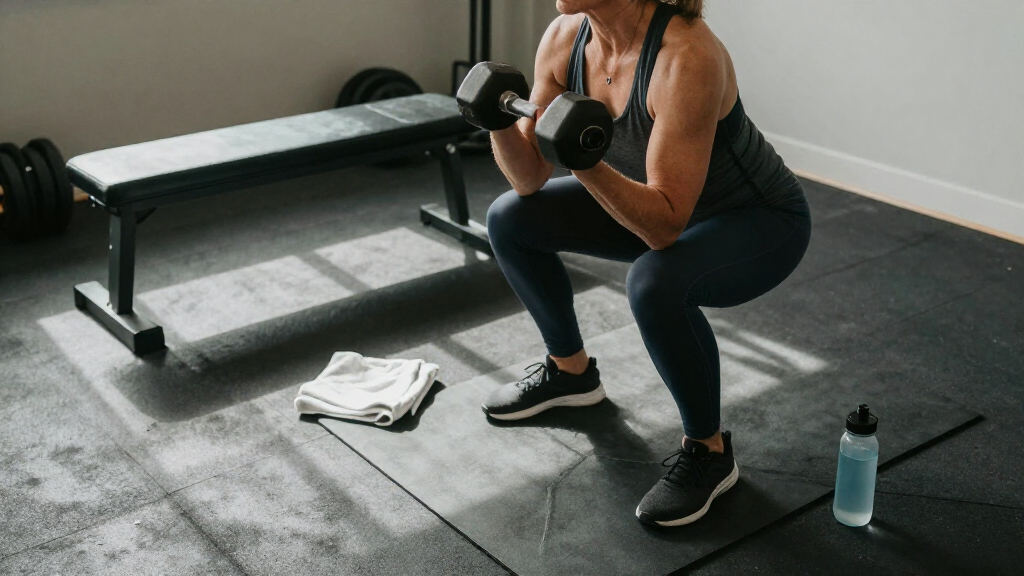
Progression is meant to follow control. Severnaia says a chair squat can later progress to a goblet squat with a light dumbbell held in front of the chest. For push-ups, she recommends lowering the hand support only when the current height can be managed without the hips sagging or the shoulders shrugging. The source does not give a fixed timeline for these progressions.
Questions the Report Leaves Open
The Fit&Well report does not specify a publication date, nor does it cite research testing this exact five-exercise sequence. It also does not set out a detailed method for choosing starting dumbbell weights, define how quickly to add load, or give a schedule for moving from one set to multiple sets. Severnaia’s guidance is presented as a trainer’s recommendation, not as a clinical prescription for every woman in her 50s.
Individual circumstances can change which movements or range of motion are appropriate. The source does not discuss adaptations for people with injuries, balance difficulties, osteoporosis diagnoses or other health conditions, and it does not provide individualized screening. Readers should not interpret the routine as a guarantee of preventing muscle loss, bone loss, falls or fractures.
Progress After Practice
The next step in Severnaia’s approach is to repeat the movements regularly while leaving enough recovery between sessions. Beginners can start with one set of eight repetitions, then build toward two or three sets of eight to 12 as control and confidence improve. The report gives no specific calendar for that increase, so progression is based on the ability to perform the movement well rather than a fixed deadline.
Changes to an exercise should remain gradual: use a light weight for the goblet squat only after the chair squat is controlled, and lower the incline push-up surface only when the higher version stays steady. The article does not identify a follow-up study, program or expert review as a next milestone. Readers seeking a plan tailored to their health or mobility can consult a qualified exercise professional or healthcare provider.
Key Questions
What five exercises does the trainer recommend?
Severnaia recommends a chair squat, Romanian deadlift, supported one-arm dumbbell row, incline push-up and farmer carry for women new to strength training in their 50s.
How often should a beginner do the routine?
Severnaia suggests two or three full-body strength sessions per week, with enough recovery between sessions. The report does not prescribe an exact weekly schedule.
How many repetitions should a beginner start with?
The suggested starting point is one set of eight repetitions for each exercise. The plan can gradually build to two or three sets of eight to 12 repetitions as the movements become controlled.
How should someone make the exercises harder?
Severnaia recommends progressing after a person can control the current version. Examples include holding a light dumbbell for a goblet squat or using a lower support for an incline push-up. The report gives no fixed timetable for increasing difficulty.
Does this routine prevent osteoporosis or falls?
The report does not show that this particular routine prevents osteoporosis, falls or fractures. Severnaia says resistance training can support muscle, bone strength, balance and physical function, but the article presents general trainer guidance rather than evidence of a guaranteed outcome.
Source: rss
Fall Picks
fall essentials
As an affiliate, we earn on qualifying purchases.