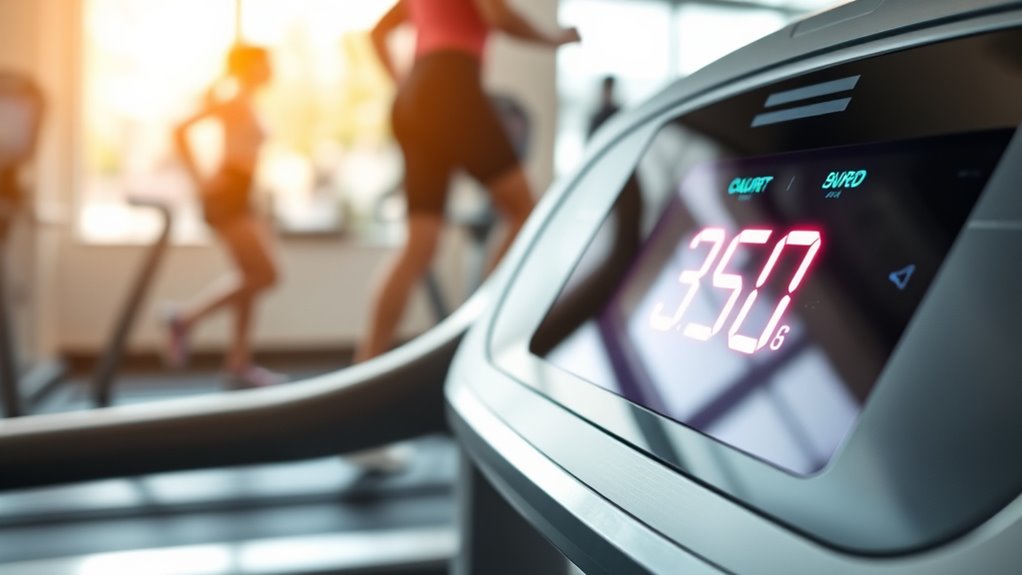

Calorie counters on exercise machines are only rough estimates that can vary widely from your actual energy expenditure. They rely on factors like weight, age, workout duration, and machine algorithms, but don’t account for individual metabolic differences or exercise form. This means your calorie counts may be over- or underestimated, especially during high-intensity or interval workouts. If you’re curious about the factors influencing these readings and how to get better results, there’s more to explore.

Get workout gear delivered free — and shop member deals
- Fast, free delivery on millions of items
- Access to Prime Big Deal Days deals on October 6–7
- Prime Video, Amazon Music and more included
Key Takeaways
- Calorie counters provide approximate estimates based on user input and activity algorithms, not precise measurements.
- Variability among different machines and models can cause inconsistent calorie readings.
- Factors like exercise intensity, form, and individual metabolism significantly affect actual calories burned.
- External influences and sensor limitations lead to discrepancies, making these counters less reliable for exact tracking.
- Overall, they are useful for general motivation and progress monitoring but should not be relied upon for precise calorie measurement.

Many modern exercise machines come equipped with calorie counters, making it easier for you to track your energy expenditure during workouts. However, understanding how accurate these readings are requires a closer look at the underlying calorie estimation methods and the exercise machine variability involved. While these counters can offer helpful motivation and general feedback, they shouldn’t be relied upon as precise measurements.
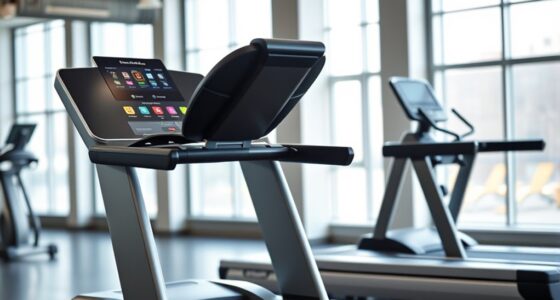
Calorie estimation methods on exercise machines typically base their calculations on factors like your weight, age, gender, and the duration of your workout. They often use algorithms built into the machine to estimate how many calories you burn based on the activity you’re doing. For example, a treadmill might consider your speed and incline, while a rowing machine factors in your stroke rate and resistance. These methods are designed to provide a quick, approximate number that encourages consistent effort and helps you monitor progress over time. Still, they aren’t perfect, mainly because they don’t account for individual variations in metabolism or workout efficiency.
Exercise machine variability plays a significant role in the accuracy of calorie counts. Different brands and models use varying sensors and algorithms, which can lead to inconsistent results. Some machines might overestimate calories burned during high-intensity intervals, while others could underestimate during steady-state cardio. Even within the same machine, calibration issues or sensor sensitivity can cause fluctuations from one session to another. The variability makes it clear that calorie readings are more of a rough guide than an exact measurement.
Another factor that influences accuracy is your input data. If you enter your weight incorrectly or haven’t updated your details after recent changes, the machine’s calculations will be skewed. Additionally, the way you perform an exercise—like using improper form or varying resistance—can impact how many calories you burn compared to what the machine estimates. Because these counters rely heavily on generalized formulas, individual differences in fitness level, muscle mass, and effort can lead to discrepancies.
Furthermore, vetted methods like wave and wind energy estimations are often employed in natural environments, but such precise measurements are rarely used in gym equipment, which contributes to the variability in accuracy.
calorie counter for exercise machines
As an affiliate, we earn on qualifying purchases.
As an affiliate, we earn on qualifying purchases.
Frequently Asked Questions
Do Calorie Counters Account for Individual Metabolic Differences?
Calorie counters on exercise machines don’t fully account for your metabolic variability. They use general formulas, so your personalized monitoring is limited. Your unique metabolism, age, weight, and fitness level influence actual calorie burn. While these machines give a helpful estimate, they can’t precisely reflect individual differences. For more accurate tracking, consider combining machine data with other methods like activity logs or wearable devices that better account for your personal metabolic rate.
How Does Machine Calibration Affect Calorie Count Accuracy?
You might think calorie count accuracy is foolproof, but machine calibration plays a sneaky role. When your equipment isn’t properly calibrated, it skews calorie accuracy, making your workout numbers less trustworthy. Regular calibration ensures the machine’s sensors and settings are spot on, giving you a more realistic estimate of calories burned. So, don’t ignore calibration; it’s the secret ingredient to truly understanding your effort.
Can User Input Errors Impact Calorie Estimates?
User input errors can considerably impact your calorie estimates, leading to inaccurate readings. If you enter incorrect details like weight, age, or workout duration, the device misreads your effort level and calories burned. Always double-check your inputs and make sure the machine is properly calibrated. This reduces the chances of device misreadings and helps you get a more accurate estimate of your exercise’s calorie-burning benefits.
Are There Specific Exercise Types Where Counters Are More Accurate?
You’ll find that calorie counters are generally more accurate during steady, consistent exercises like walking or cycling, where machine variability is lower. However, your user experience, including how well you input data and maintain proper form, can still influence accuracy. For more reliable estimates, stick to exercises with predictable movement patterns, and be mindful of how machine variability and your effort impact the readings.
How Often Should Exercise Machines Be Recalibrated for Accuracy?
You should recalibrate your exercise machine at least every six months, or more often if it starts giving wildly inaccurate readings—like claiming you burned 500 calories after a leisurely walk. Regular machine maintenance and sticking to calibration schedules guarantee your data stays trustworthy. Don’t wait for your machine to become a fitness fraud—schedule calibrations proactively and keep your workout honest and effective.
best fitness tracker for calorie burn
As an affiliate, we earn on qualifying purchases.
As an affiliate, we earn on qualifying purchases.
Conclusion
While calorie counters on exercise machines can feel like your personal fortune-teller, they often overestimate what you burn. Think of them as a weather forecast—helpful but not always spot-on. To get a clearer picture, track your progress over time and consider using additional methods like heart rate monitors. Remember, these counters are just a rough sketch, not the full masterpiece of your fitness journey. Trust your body’s signals and stay consistent—you’re the true engine behind your progress.
accurate calorie monitor for gym equipment
As an affiliate, we earn on qualifying purchases.
As an affiliate, we earn on qualifying purchases.
exercise machine calorie estimation device
As an affiliate, we earn on qualifying purchases.
As an affiliate, we earn on qualifying purchases.
Evergreen bestsellers Picks
bestsellers
As an affiliate, we earn on qualifying purchases.