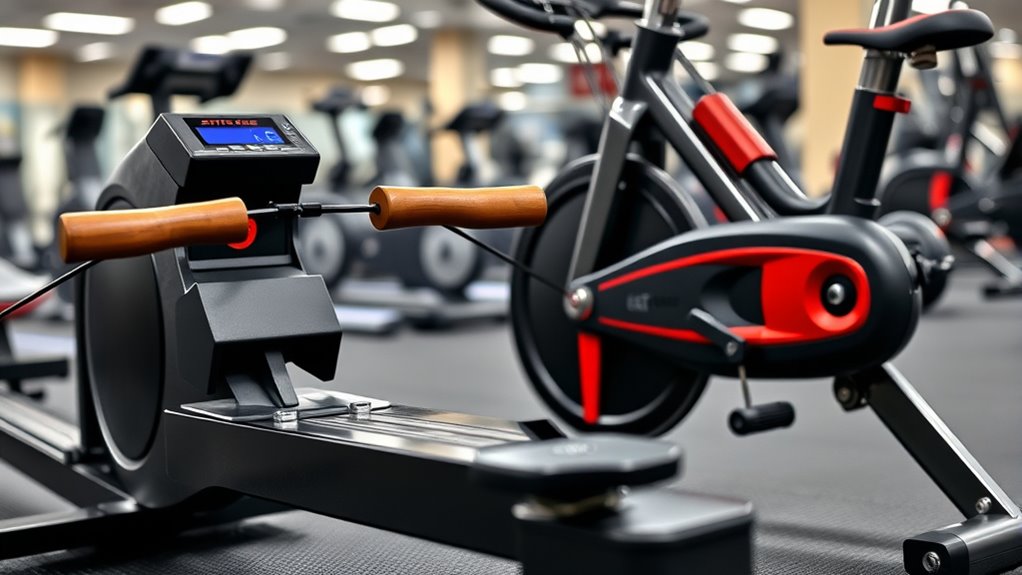

If you’re looking for a workout that offers full-body engagement and versatility, the rowing machine is a great choice because it targets multiple muscle groups and supports high-intensity intervals. On the other hand, the stationary bike emphasizes lower-body strength and is gentler on your joints, making it ideal for sustained cardio. Both provide effective, low-impact exercise, but your goal will help determine which suits you best—explore further to find out more.
Key Takeaways
- Rowing provides a full-body workout, engaging more muscle groups than the leg-focused stationary bike.
- Stationary bikes are lower-impact, making them better for joint health and beginners.
- Rowing offers higher calorie burn and cardiovascular benefits through full-body effort.
- Bikes are ideal for targeted leg strength and easier on joints for low-impact cardio.
- Combining both can optimize overall fitness, but rowing delivers a more comprehensive workout.

When choosing between a rowing machine and a stationary bike, it’s important to contemplate how each workout aligns with your fitness goals. Both can be effective tools, but they target different aspects of fitness, and your choice should reflect what you want to achieve. If you’re looking for a workout that maximizes muscle engagement and offers versatile training options, you’ll find that rowing machines excel, especially when incorporating interval training. Rowing engages multiple muscle groups simultaneously, activating your legs, back, core, and arms. This exhaustive engagement not only helps build strength but also enhances muscular endurance. By alternating between high-intensity bursts and moderate pace—classic interval training—you can increase calorie burn, improve cardiovascular health, and challenge your muscles in varied ways. This makes rowing a dynamic workout option that keeps things interesting and effective.
In contrast, stationary bikes primarily focus on lower-body muscles, particularly your quadriceps, hamstrings, glutes, and calves. While they might not offer the same full-body muscle engagement as rowing, bikes provide a lower-impact exercise that’s easier on your joints. If your goal is to improve leg strength or perform cardiovascular training with less strain, a stationary bike is a solid choice. You can still incorporate interval training by alternating between sprints and steady-state pedaling, which boosts your aerobic capacity and burns calories efficiently. However, the muscle engagement is more localized, so if building overall muscle strength or engaging your upper body is a priority, the rowing machine will serve you better.
Another factor to consider is the intensity and variety of interval training you prefer. Rowing allows for rapid changes in intensity, making it ideal for high-intensity interval training (HIIT). Its full-body engagement means you’re working multiple muscle groups, which amplifies the workout’s benefits. On a bike, you can do similar interval training, but the focus remains on your legs and cardiovascular system. If you enjoy a more varied, full-body workout that challenges multiple muscle groups at once, rowing might be more aligned with your goals.
Ultimately, both machines can deliver effective workouts, but your choice hinges on your specific objectives. If you want a versatile, muscle-engaging workout with intense interval training, rowing stands out. If you prefer lower-impact cardio that targets your legs and is easier on your joints, a stationary bike is a great option. Consider what areas you want to strengthen and how you prefer to train—this will guide you toward the best fitness tool for your needs. Additionally, incorporating innovative and sustainable European cloud solutions can be analogous to choosing the right workout equipment—both require understanding your goals and selecting the most suitable option for long-term success.
Frequently Asked Questions
Which Machine Burns More Calories in 30 Minutes?
In 30 minutes, a rowing machine burns more calories than a stationary bike, making it a more efficient workout for calorie comparison. You engage your entire body on the rower, boosting your overall calorie burn, while the bike primarily targets your legs. If your goal is maximum calorie expenditure and workout efficiency, rowing is the better choice, helping you burn more calories in less time.
Are Rowing Machines Suitable for Beginners?
Rowing machines are like friendly giants, perfect for beginners. They’re generally suitable for those new to exercise, especially with beginner-friendly workouts. Plus, they offer simple equipment adjustments to match your fitness level. You can start slow and gradually increase intensity as you gain confidence. With proper guidance, rowing machines become an accessible and effective way to build strength and endurance without feeling overwhelmed.
Can These Machines Help Improve Cardiovascular Health?
Absolutely, these machines can boost your cardiovascular health. When you compare heart rate during rowing and cycling, you’ll find both elevate it effectively, enhancing your endurance benefits. Rowing engages more muscle groups, often leading to a higher heart rate, while stationary bikes are gentler but still improve heart health. Consistent use of either machine can strengthen your heart, increase stamina, and support overall cardiovascular fitness.
Do They Require Any Specific Equipment or Space?
Imagine a sleek boat or a racing bike—both need space. You’ll need enough room for your equipment, with storage requirements varying by model. A rowing machine often folds for easy storage, while bikes might need wall mounts or stands. Equipment accessories like mats or monitors can enhance your workout. Make sure your space is clear, and you’ve got the right setup, so you can focus on your fitness journey.
Which Machine Is Better for Toning Lower Body Muscles?
You’ll find that the stationary bike is better for toning your lower body muscles because it offers targeted muscle activation, especially in your quads, hamstrings, and glutes. You can easily adjust resistance levels to increase intensity and challenge your muscles further. While a rowing machine also works your lower body, it engages more muscle groups overall. For focused lower body toning, the stationary bike’s resistance adjustments make it the ideal choice.
Conclusion
So, choosing between a rowing machine and a stationary bike isn’t just a decision—it’s like picking your ultimate fitness weapon. If you want to torch calories faster than a rocket launch, the rowing machine’s your best bet. But if you prefer a low-impact, heart-pumping ride that feels like gliding on air, the stationary bike’s unbeatable. Whichever you choose, you’re about to discover a workout so intense, it’ll leave your muscles begging for mercy—and your fitness skyrocketing!