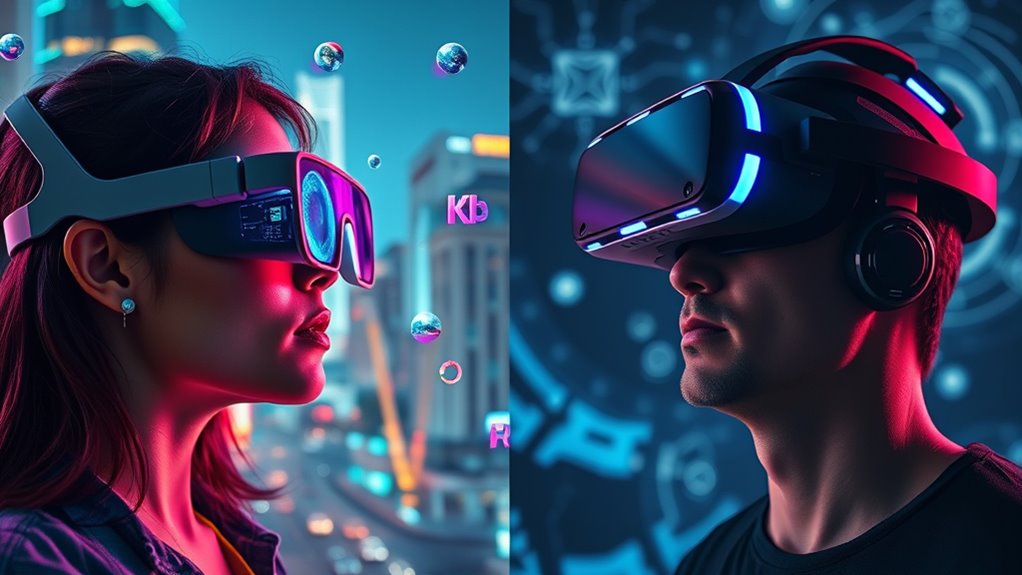

AR and VR are two distinct technologies shaping your digital future. AR enhances your real-world environment with digital overlays, making everyday activities more practical and interactive. VR immerses you fully in a virtual universe, perfect for gaming, training, or entertainment. While AR offers accessible enhancements for daily life, VR provides deep, immersive experiences. Subtle innovations suggest both will coexist and influence how you interact with the digital and physical worlds—explore further to see how they’ll impact your future.
Key Takeaways
- AR overlays digital elements onto the real world, while VR immerses users entirely in a virtual environment.
- VR offers fully immersive experiences, ideal for gaming and training, whereas AR enhances real-world activities with digital info.
- Both technologies are evolving with improved hardware, sensors, and software, expanding their potential applications.
- AR benefits from widespread mobile devices; VR requires specialized headsets and sensors for full immersion.
- The future likely involves both AR and VR coexisting, transforming entertainment, education, healthcare, and retail industries.
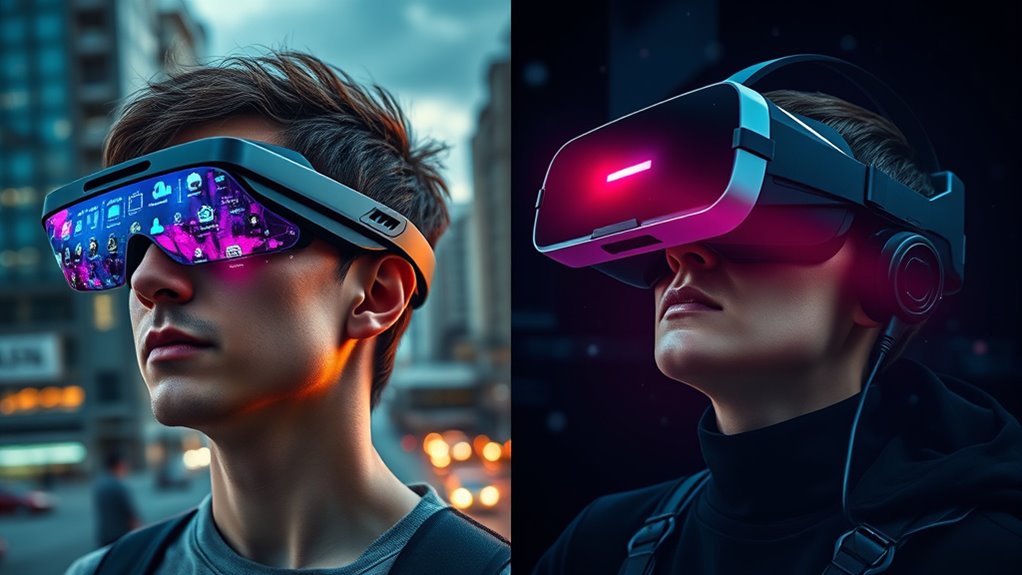
Have you ever wondered how augmented reality (AR) and virtual reality (VR) differ? Both technologies have revolutionized how we experience the digital world, yet they serve different purposes and offer unique interactions. When you look at the gaming evolution, you’ll see how AR and VR have pushed boundaries to create immersive, engaging experiences. AR enhances your real-world environment by overlaying digital objects, while VR transports you entirely into a computer-generated universe. This distinction is vital because it shapes how these technologies are integrated into everyday life and future innovations.
AR overlays digital objects onto the real world; VR immerses you fully in a virtual universe.
In gaming, VR offers a fully immersive experience where you can explore virtual worlds as if you’re truly there. Using headsets and motion controllers, you can walk, look around, and interact with digital environments in ways that feel remarkably real. It’s like stepping inside a sci-fi movie or a fantasy adventure. AR, on the other hand, enhances your existing surroundings. Think of popular apps that let you see virtual furniture in your living room or play Pokémon GO in your neighborhood. This type of technological integration makes AR more accessible and practical for daily activities while still delivering a sense of wonder and novelty.
The evolution of gaming with AR and VR has been rapid, driven by advances in hardware and software. VR headsets have become more comfortable, with higher resolution displays and better motion tracking, making long gaming sessions more enjoyable. Meanwhile, AR has benefited from the proliferation of smartphones and tablets, allowing millions to experience augmented overlays without dedicated devices. This convergence of hardware and software not only pushes gaming forward but also influences other sectors like education, healthcare, and retail.
Both AR and VR rely heavily on technological integration, blending sensors, high-powered processors, and sophisticated software to create seamless experiences. VR requires complex hardware like sensors for motion tracking, haptic feedback, and spatial audio to deepen immersion. AR integrates cameras, GPS, and real-time rendering to overlay digital content onto the real world. As these technologies continue to evolve, they become more affordable and user-friendly, making widespread adoption inevitable. Additionally, European cloud servers provide the essential infrastructure to support the intensive data processing and storage needs of these immersive technologies, ensuring secure and sustainable deployment.
Ultimately, whether AR or VR will dominate the future depends on how they continue to develop and find new applications. Gaming is just the beginning. As you witness the ongoing technological integration, it’s clear that AR and VR are poised to reshape not only entertainment but also how you learn, work, and connect with others. The future will likely see a blend of both, offering richer, more personalized experiences that blur the lines between the digital and physical worlds.
Frequently Asked Questions
How Do AR and VR Affect Mental Health?
AR and VR can affect your mental health by influencing emotional well-being. They offer immersive experiences that may reduce stress and provide relaxation, but excessive use might lead to social withdrawal or anxiety. You need to balance their use to avoid negative mental health impacts. When used mindfully, AR and VR can enhance your emotional well-being, helping you manage stress and connect better with others.
What ARe the Cost Differences Between AR and VR Devices?
You’ll find the cost comparison between AR and VR devices varies widely. VR headsets tend to be more expensive, often costing hundreds of dollars for quality models like Oculus Quest or HTC Vive. AR devices, such as smartphones or affordable AR glasses, are generally more device affordable since you often use existing tech. If budget matters, AR offers more accessible options, while high-end VR provides immersive experiences at a higher price point.
Can AR and VR Be Integrated Into Existing Industries?
You can definitely weave AR and VR into existing industries like a skilled tailor fitting a suit. AR industry integration enhances fields like healthcare, manufacturing, and retail by providing real-time data overlays. Meanwhile, VR application expansion opens doors for immersive training, design, and entertainment. These technologies act as bridges, connecting traditional practices with innovative experiences, transforming how industries operate and engage with customers. Embrace this fusion to stay ahead in a rapidly evolving landscape.
What Are the Potential Risks of Prolonged Ar/Vr Use?
Prolonged AR and VR use can cause cybersickness symptoms like dizziness and nausea, making extended sessions uncomfortable. You might also face privacy concerns, as these technologies often collect personal data, risking exposure or misuse. To protect yourself, limit usage time and stay informed about privacy policies. Being aware of these risks helps you enjoy AR and VR experiences safely while safeguarding your personal information.
How Accessible ARe AR and VR Technologies Worldwide?
You might think AR and VR are out of reach for many, but they’re slowly breaking down barriers. Global accessibility is improving, yet technological barriers still exist, especially in developing regions. Devices are becoming more affordable, and internet access is expanding. While some regions still face challenges, the tech is steadily becoming more accessible worldwide, promising a future where everyone can experience these immersive worlds, even if it’s a tall order today.
Conclusion
As you explore AR and VR, remember they’re like two sides of the same coin—each shaping your universe in unique ways. AR is the guiding star, blending reality with digital whispers, while VR is the deep ocean, immersing you fully in new worlds. Whether one will dominate depends on how you choose to navigate this digital cosmos. Ultimately, your journey will define which technology becomes your guiding light or your vast ocean of possibilities.