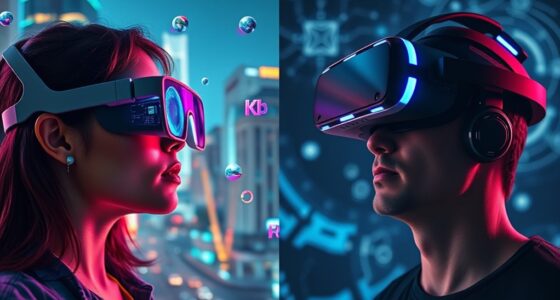
Face recognition technology opens devices and enhances security by analyzing facial features to verify identities quickly and accurately. It makes your daily interactions seamless, from unlocking smartphones to secure checkpoints. However, it also raises privacy concerns, as it involves collecting sensitive biometric data that could be misused or accessed without consent. The technology continues to evolve, improving accuracy and broadening applications, but it’s important to contemplate the ethical questions that come with it. Keep exploring to uncover what’s behind the magic and controversy.
Listen free for 30 days with Audible
Thousands of audiobooks and originals — cancel anytime.
As an affiliate, we earn on qualifying purchases.
Key Takeaways
- Face recognition technology offers seamless device access and security by analyzing unique facial features for instant identification.
- It raises privacy concerns due to biometric data collection, potential misuse, and risks of mass surveillance without consent.
- Advances in AI and machine learning improve accuracy in various conditions, enabling applications like law enforcement and personalized marketing.
- Ethical and regulatory frameworks are essential to balance technological benefits with protecting individual rights and privacy.
- Despite its benefits, face recognition technology faces controversy over data security, misuse, and the extent of surveillance.
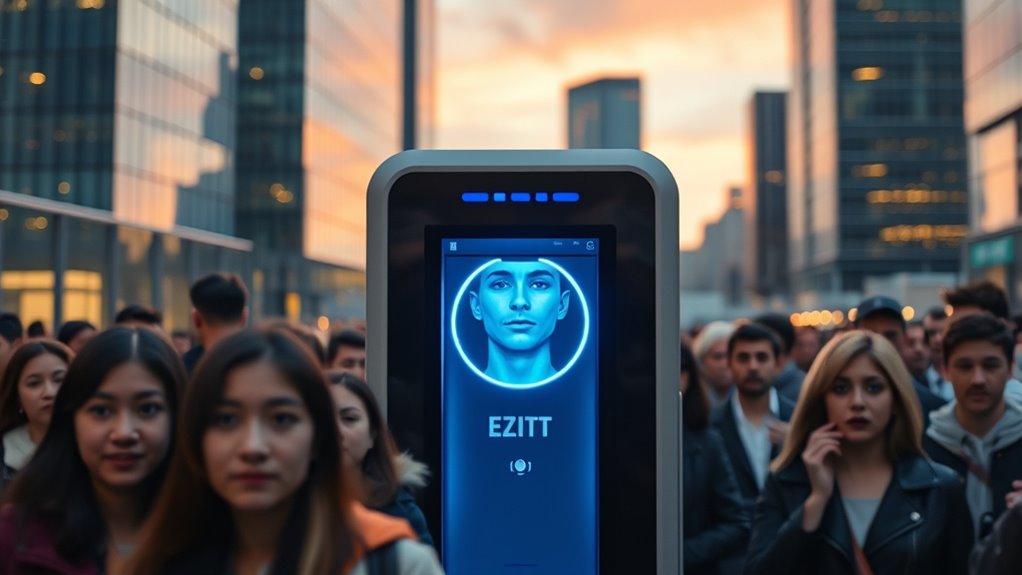
Have you ever wondered how your smartphone opens instantly or how airports verify your identity so quickly? The answer lies in face recognition technology, a groundbreaking innovation powered by recent technological advancements. This technology uses sophisticated algorithms to analyze your facial features—like the distance between your eyes, the shape of your jawline, and the contours of your face—and create a unique digital map. When you look into a device or approach a security checkpoint, that map is compared against stored data to confirm your identity in seconds. These rapid processes have transformed daily experiences, making access to devices and secure locations more seamless than ever before.
However, as you benefit from the convenience, you might also have concerns about privacy. Face recognition tech collects and stores sensitive biometric data, which raises questions about how that data is secured and used. Many worry that this information could be misused or accessed without consent, especially as governments and private companies increasingly deploy these systems. Privacy concerns stem from the potential for mass surveillance, tracking individuals without their knowledge, and the possibility of data breaches exposing personal information. You might feel uneasy about how your facial data is stored, whether it’s encrypted, and who has access to it. These concerns prompt ongoing debates about balancing technological progress with the preservation of personal privacy rights.
Advancements in technology continue to push face recognition further, making it more accurate and versatile. Machine learning models are now capable of distinguishing faces in crowded places, even with changes in lighting, angles, or facial expressions. Enhanced algorithms can identify people with a high degree of precision, reducing false positives and negatives. This progress has opened up new applications—like personalized marketing, attendance tracking, and law enforcement investigations. Additionally, improvements in contrast ratio and image processing have contributed to the increased effectiveness of face recognition systems, enabling clearer and more detailed facial analysis. Nevertheless, these technological advancements come with a responsibility to implement safeguards. Developers and regulators are increasingly focused on creating frameworks that protect individual rights while leveraging the benefits of face recognition.
Frequently Asked Questions
How Accurate Is Face Recognition Technology Across Different Demographics?
You should know that face recognition technology’s accuracy varies across different demographics, with notable disparities. It often performs better with certain ethnicities and skin tones, leading to accuracy challenges for others. These demographic disparities mean you might experience false positives or negatives depending on your background. Developers are working to improve fairness, but current systems still struggle to deliver consistent accuracy for everyone, highlighting the need for ongoing improvements and caution in use.
What Are the Privacy Risks Associated With Facial Recognition Data?
You might think privacy risks are exaggerated, but biometric bias and data breach risks are real concerns. Facial recognition data can be hacked or misused, leading to identity theft or unwarranted surveillance. Even if technology improves, your data remains vulnerable. Protecting your biometric information is vital, as breaches could expose sensitive details, fueling distrust and potential discrimination. Stay informed and cautious about how your facial data is collected and stored.
How Is Facial Data Stored and Protected by Companies?
Companies store your facial data using secure servers with data encryption and biometric security measures. They often anonymize data to protect your identity and limit access to authorized personnel. You should know that robust encryption safeguards your information from hacking, while biometric security adds an extra layer of protection. Still, it’s smart to stay informed about how your data is managed and advocate for stronger privacy protections.
Can Face Recognition Be Fooled by Fake Images or Masks?
Like a magician’s trick, face recognition can be fooled by fake images or masks, but it’s not foolproof. Advanced algorithms now detect subtle differences in real faces versus fake ones, yet clever disguises still pose challenges. You should stay aware that while technology improves, some fake images and masks can still temporarily deceive systems, reminding you that no method is entirely invincible in this digital age.
What Legal Regulations Govern the Use of Facial Recognition Worldwide?
You need to know that international privacy laws and data sovereignty heavily regulate facial recognition use worldwide. Countries like the EU enforce strict GDPR rules, requiring transparency and consent. In contrast, others have looser policies or lack exhaustive regulations. You’re responsible for understanding these laws to guarantee legal compliance, especially when handling biometric data across borders. Ignoring these regulations can lead to severe penalties and privacy breaches.
Conclusion
As you explore face recognition technology, you realize it’s a double-edged sword—unlocking incredible convenience while sparking epic debates about privacy and ethics. This tech’s potential to transform security and daily life is nothing short of revolutionary, but it also threatens your personal privacy like a storm on the horizon. Staying informed and cautious is your best weapon, ensuring you harness its power responsibly. After all, this isn’t just tech; it’s the future knocking at your door.
Flea & tick season Picks
flea and tick prevention
As an affiliate, we earn on qualifying purchases.