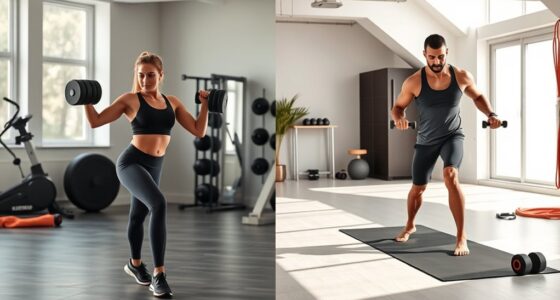
You can build strong, toned legs at home by doing bodyweight squats, lunges, glute bridges, and step-ups, all without gym machines. Add resistance by holding household items like water bottles or backpacks. Focus on proper form, slowly increase repetitions, and include variations like single-leg bridges or walking lunges for variety. Keep challenging yourself with weights or pulses. Stay committed, and you’ll discover more effective moves that target your lower body even further.
Key Takeaways
- Bodyweight squats and lunges effectively target quads, hamstrings, glutes, and core without equipment.
- Household items like water bottles or backpacks can add resistance for increased strength.
- Glute bridges and single-leg variations enhance glute engagement and stability at home.
- Step-ups using stairs or sturdy furniture mimic stair climbing to strengthen legs and glutes.
- Combining these exercises creates a comprehensive, equipment-free leg workout for strong legs.
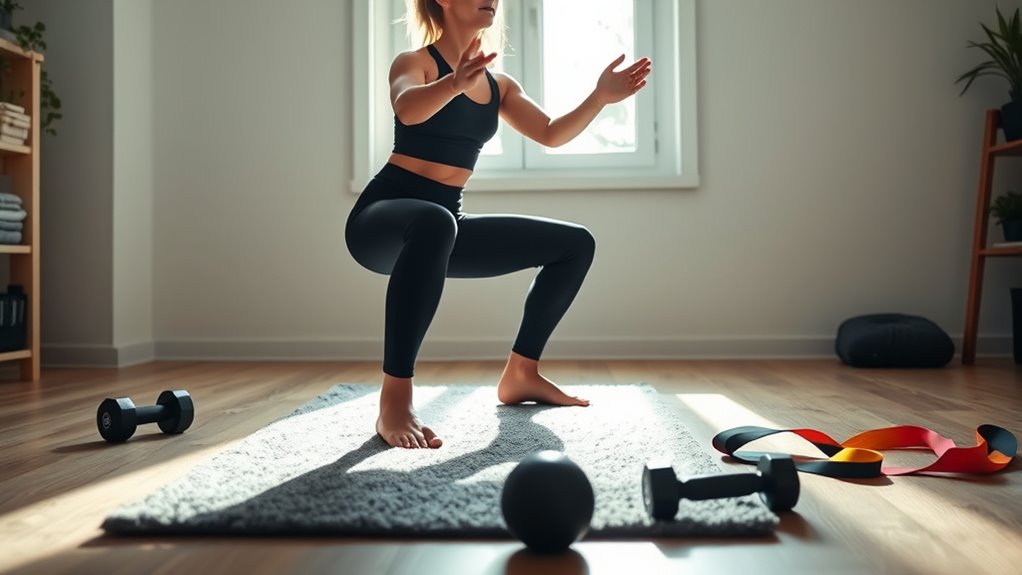
Ever wondered how to get a solid leg workout without hitting the gym? The good news is that you can build strong legs right at home using bodyweight workouts and equipment alternatives. You don’t need fancy machines or weights to challenge your muscles; instead, focus on leveraging your body weight and everyday household items to create effective exercises. This approach not only saves you money but also makes your workout more flexible and accessible.
Start with bodyweight squats, a fundamental movement that targets your quads, hamstrings, glutes, and even your core. Stand with your feet shoulder-width apart, keep your chest up, and push your hips back as if sitting in a chair. Lower yourself until your thighs are parallel to the floor, then drive through your heels to stand back up. To intensify the workout, try pause squats or pulse squats, which increase time under tension. If you want to make it more challenging without weights, use equipment alternatives like holding a heavy backpack or filled water bottles close to your chest to add resistance.
Lunges are another excellent bodyweight workout for your lower body, engaging multiple muscles and improving balance. Step forward with one leg, lowering your hips until both knees are bent at about 90 degrees. Push through the heel of your front foot to return to the starting position, then switch legs. You can perform stationary lunges or walking lunges across your living room. To ramp up difficulty, hold household items such as canned goods or water jugs in each hand. If balance is an issue, perform step-back lunges instead, which tend to be easier to control.
Glute bridges are fantastic for targeting your posterior chain and can be done on the floor. Lie on your back with knees bent and feet flat on the ground, hip-width apart. Push through your heels to lift your hips until your body forms a straight line from shoulders to knees. Squeeze your glutes at the top, then lower slowly. To increase resistance, place a weight, like a heavy book or a backpack filled with books, on your hips. Single-leg glute bridges challenge your stability and strength even more.
Finally, don’t forget about step-ups, which mimic climbing stairs and work your glutes, quads, and hamstrings. Use a sturdy chair, bench, or even a staircase. Step onto the elevated surface with one foot, then bring the other up, standing tall. Step back down and repeat. To make this more intense, hold household weights or a filled backpack to add resistance. Incorporating these bodyweight workouts and equipment alternatives ensures you can maintain a thorough leg day routine at home, building strength and endurance without any gym equipment. Additionally, understanding the importance of proper form and muscle engagement helps maximize your results and reduce the risk of injury.
Frequently Asked Questions
Can I Build Muscle With Only Bodyweight Exercises?
Yes, you can build muscle with only bodyweight exercises. They effectively promote muscle activation through movements like squats, lunges, and glute bridges. To see continuous gains, focus on exercise variety by increasing reps, tempo, or adding variations. Consistency and proper form are key. While you might eventually need equipment for advanced growth, bodyweight exercises are a great way to develop strength and muscle at home.
How Often Should I Do Leg Workouts at Home?
You should aim for leg workouts at home 2 to 3 times a week, allowing adequate recovery between sessions. Focus on training frequency that challenges your muscles without overtraining, and incorporate recovery strategies like stretching, hydration, and rest days. Listen to your body, and if you feel sore or fatigued, give yourself extra recovery time. This balance helps build strength while preventing injuries and optimizing progress.
What Are the Best Stretches for Preventing Leg Injuries?
They say “prevention is better than cure,” so start with dynamic stretching before your workout to warm up muscles and improve flexibility. Incorporate leg swings, walking lunges, and high knees. After exercising, use foam rolling to release muscle tension and prevent tightness. This combination keeps your legs injury-free and ready for your next workout, making your training safer and more effective.
Is It Necessary to Warm up Before Every Leg Session?
Yes, you should warm up before every leg session. Dynamic stretching helps increase blood flow and loosen muscles, reducing injury risk. A proper warm-up prepares your body for intense exercise and enhances performance. After your workout, don’t forget to cool down routines to gradually lower your heart rate and stretch muscles, aiding recovery. Skipping warm-ups can lead to strains or pulls, so make it a crucial part of your exercise routine.
How Do I Progress if Exercises Become Too Easy?
When exercises become too easy, you can progress by using progression techniques like increasing resistance. For example, if you’re doing bodyweight squats, add resistance bands or hold weights to challenge yourself. To keep improving, gradually increase the difficulty or reps. This way, you continually push your muscles, ensuring consistent strength gains without plateauing, making your workouts more effective and engaging over time.
Conclusion
As you finish your at-home leg day, remember that consistency strengthens more than just muscles—it builds resilience. Sometimes, the simplest exercises, like a squat or lunge, remind us that progress often comes from the smallest efforts. Just like the quiet mornings you dedicate to your routine, these workouts become a natural part of your day. In the end, every step you take at home brings you closer to stronger legs—and a stronger, more confident you.