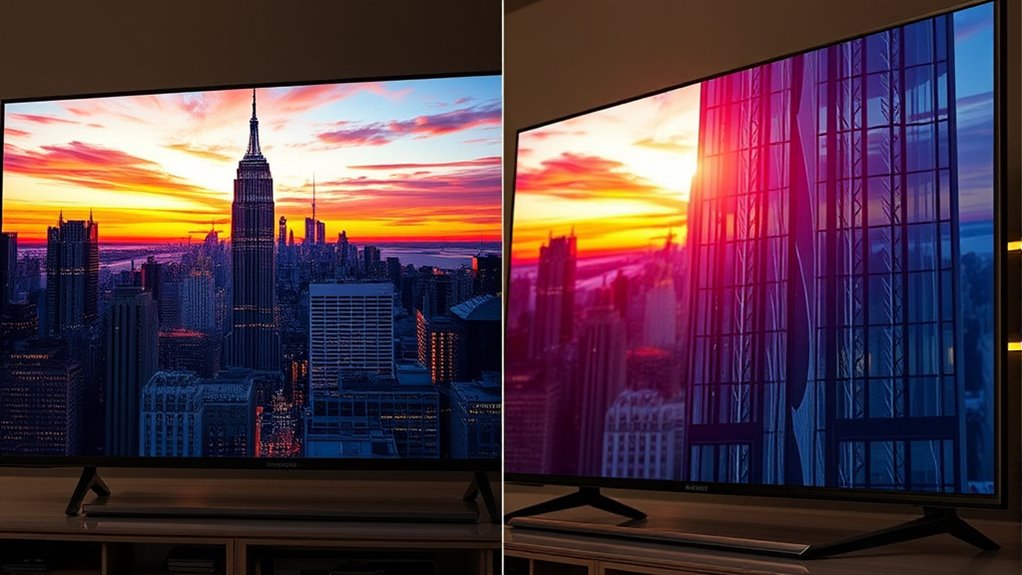

If you’re wondering whether your eyes can tell the difference between 4K and 8K TVs, it’s likely limited at typical viewing distances. Human eyes can only discern so much detail, especially unless you’re sitting very close to a large screen. Plus, most content isn’t native 8K yet, making the extra resolution less noticeable. To get a clearer picture, there’s more to weigh about screen size, content, and viewing habits—so stay with us to learn more.

Get workout gear delivered free — and shop member deals
- Fast, free delivery on millions of items
- Access to Prime Big Deal Days deals on October 6–7
- Prime Video, Amazon Music and more included
Key Takeaways
- Human eyes have limited ability to distinguish ultra-fine details beyond a certain resolution.
- The difference between 4K and 8K is less noticeable at typical viewing distances and screen sizes.
- Larger screens (75 inches or more) and close viewing enhance the perceived benefits of 8K resolution.
- Most content is still limited to 4K or lower, reducing the immediate advantage of 8K TVs.
- Higher resolution benefits are more apparent with native 8K content and in close-up viewing environments.
With advancements in display technology, choosing between 4K and 8K TVs can be confusing. The key difference lies in the resolution comparison: 4K TVs typically feature 3,840 x 2,160 pixels, while 8K models boast four times that amount at 7,680 x 4,320 pixels. At first glance, it might seem like an obvious upgrade, but whether you’ll notice a significant difference in your viewing experience depends on a few factors. For most viewers, the leap from 4K to 8K isn’t as dramatic as it sounds, especially when sitting at a typical viewing distance. The human eye has limitations, and beyond a certain pixel density, the additional detail becomes less perceptible.
Your viewing experience, in terms of clarity and sharpness, does improve with higher resolution, but only if the content is native 8K or properly upscaled. If you’re watching standard 4K content on an 8K TV, the differences are often subtle. Many manufacturers use sophisticated upscaling algorithms to fill in the gaps, but this process can’t truly replicate native 8K resolution. So, if you’re contemplating an 8K TV mainly to future-proof your setup, it’s worth noting that content availability is still limited. Streaming services and broadcasters are just beginning to adopt 8K, meaning you might not see the full benefit right away.
Native 8K content is limited; upscaling helps but can’t fully replicate true 8K resolution.
Another aspect to think about is the size of the screen. Larger TVs—say, 75 inches or bigger—can showcase more of the resolution’s advantages because pixels are spread out over a bigger area. On smaller screens, the difference between 4K and 8K is less noticeable, especially at normal viewing distances. If you’re sitting several feet away from your TV, your eyes may not be able to detect the pixel density difference at all. However, if you’re close to the screen, such as in a dedicated home theater, the clarity of 8K can provide a more immersive experience, but only if the content matches the resolution.
Ultimately, your decision should take into account the resolution comparison, your viewing habits, and the content you consume. While 8K promises incredible detail, the reality is that current content and viewing distances often mean you won’t see a big difference unless you’re sitting very close to a large screen. For most everyday viewers, a high-quality 4K TV remains a fantastic choice, delivering sharp visuals and an engaging viewing experience without the added cost or limited content of 8K.
As an affiliate, we earn on qualifying purchases.
Frequently Asked Questions
Do 8K TVS Have Better Color Accuracy Than 4K?
8K TVs generally don’t have better color accuracy than 4K models, as color calibration depends more on the panel quality and processing technology. While 8K screens have higher pixel density, this mainly enhances sharpness and detail, not color fidelity. To get the best colors, look for TVs with advanced color calibration features and high-quality panels. So, don’t assume 8K automatically means better color—focus on calibration and panel quality instead.
Is Content Available in 8K Resolution Currently?
Yes, content available in 8K resolution is limited but growing. Resolution standards are evolving, and some streaming platforms and broadcasters are starting to offer 8K videos. However, current content availability remains sparse, mostly focusing on demo videos or specialized productions. If you want to experience 8K, you’ll need a compatible device and access to 8K content, but for most viewers, 4K remains the highest practical resolution.
How Does Screen Size Affect Perceivable Resolution Differences?
As your screen size grows, subtle differences in pixel density become more noticeable, especially if you’re close enough to see individual pixels. Larger screens demand a higher resolution or closer viewing distance to perceive the added detail. If you sit far back, even a massive 8K TV might appear similar to a 4K. To truly notice the difference, optimize your viewing distance and consider the size of your display.
Are 8K TVS More Energy-Efficient Than 4K Models?
8K TVs aren’t necessarily more energy-efficient than 4K models. While they might have similar energy consumption, their higher resolution can lead to increased power use, especially when displaying detailed content. However, modern 8K TVs often include power-saving features to improve overall power efficiency. Ultimately, your energy consumption depends on the TV’s size, settings, and usage habits, not just its resolution.
Can Streaming Services Support 8K Content Now?
You might be surprised—streaming services are starting to support 8K content, but it’s not widespread yet. Video compression techniques are improving, making 8K streaming possible, but you’ll need compatible hardware to enjoy it smoothly. Keep in mind, many platforms still focus on 4K. If you’re enthusiastic for 8K, stay updated on service offerings and guarantee your device can handle the latest codecs and hardware requirements to open this ultra-high-definition experience.
As an affiliate, we earn on qualifying purchases.
Conclusion
Imagine standing close to a painting and noticing every tiny brushstroke—that’s how 8K TVs might seem, but for most of us, the difference is like spotting a single grain of sand on a vast beach. While 8K offers stunning detail, your eyes might not catch it unless you’re right up close. So, unless you’re a professional or a dedicated enthusiast, 4K TVs already deliver breathtaking clarity, making the leap to 8K feel like chasing a mirage in the distance.
native 8K content streaming device
As an affiliate, we earn on qualifying purchases.
As an affiliate, we earn on qualifying purchases.
As an affiliate, we earn on qualifying purchases.
Fall Picks
fall essentials
As an affiliate, we earn on qualifying purchases.