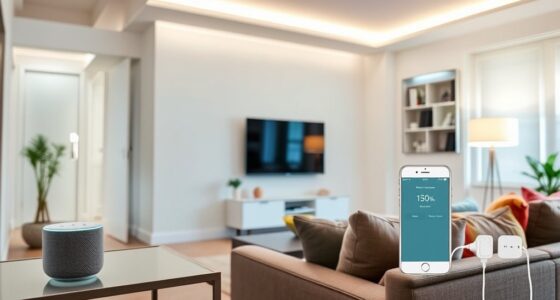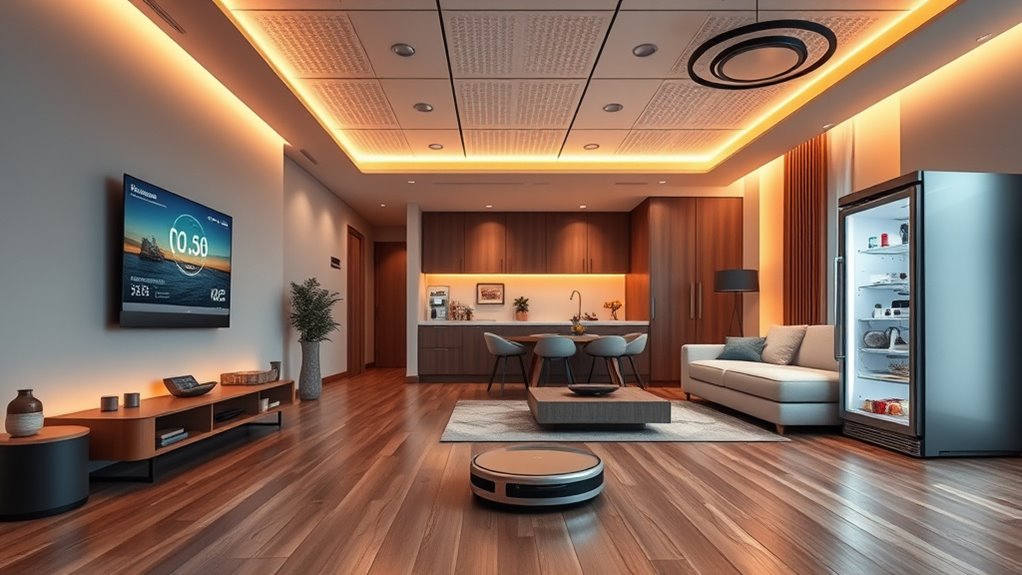

A fully connected smart home uses IoT technology to make your life easier, safer, and more efficient. Your devices communicate seamlessly, adjusting lighting, temperature, and security based on your routines. It responds automatically to environmental cues, like locking doors when you’re away or saving energy when you’re asleep. Personalization improves over time with AI and voice assistants. If you keep exploring, you’ll discover how these innovations will reshape daily living and bring greater convenience and control to your home.
Key Takeaways
- Homes will feature seamless device integration, creating a responsive ecosystem that adapts to residents’ needs automatically.
- Advanced security systems will provide real-time monitoring, proactive threat detection, and automatic responses for enhanced safety.
- Energy management will optimize comfort and efficiency by automating lighting, heating, and appliance use based on routines and environmental data.
- Interconnected systems will coordinate responses, such as locking doors or conserving power, based on environmental cues and user activity.
- Future homes will incorporate AI and voice assistants for smarter automation, personalized suggestions, and continuous system improvements.

Have you ever wondered how the Internet of Things (IoT) will transform our daily lives in the coming years? Imagine a fully connected home where every device communicates seamlessly to make life easier, safer, and more efficient. In this future, smart home security will become more advanced, giving you peace of mind with real-time monitoring and automated alerts. Your security system will learn your routines, adjusting cameras, locks, and alarms based on your preferences. If an unusual movement is detected when you’re away, your home’s smart security will instantly notify you and even activate cameras or lock doors automatically. This integration guarantees that your home is always protected without constant manual oversight, offering a sense of safety that’s both reliable and intelligent.
Alongside security, energy management will reach new heights. Your IoT-enabled home will optimize energy use by learning your habits and adjusting systems accordingly. For instance, smart thermostats will analyze your schedule and weather patterns to maintain comfort while reducing energy waste. Lights will turn off when rooms are unoccupied, and appliances will operate during off-peak energy times, saving you money and reducing your carbon footprint. This level of automation not only makes your home more eco-friendly but also simplifies your daily routines, removing the need for constant manual adjustments.
In a fully connected home, these systems won’t operate in isolation. They’ll work together, creating a cohesive ecosystem that responds dynamically to your needs. For example, if your smart security system detects an open window, it might trigger your smart locks to secure all entry points and adjust your energy management system to conserve power, preventing unnecessary heating or cooling. Your home will become an intuitive environment that adapts to your lifestyle, whether you’re home, away, or asleep.
Moreover, as IoT technology evolves, these systems will become even smarter, integrating with voice assistants and AI to anticipate your needs. You might find your home suggesting energy-saving tips or alerting you to security concerns before they happen. The data collected will help refine these systems, making them more personalized and efficient over time. As IoT technology advances and becomes more widespread, homes will be able to provide even more seamless and intelligent experiences for their inhabitants. The future of IoT promises homes that are not only more secure and energy-efficient but also more responsive and user-centric. This interconnected world will redefine what it means to live comfortably and sustainably, all at the touch of a button or the sound of your voice.
Frequently Asked Questions
How Secure Are Fully Connected Home Devices From Cyber Threats?
Fully connected home devices face cybersecurity challenges, but their security depends on your actions. Many devices use data encryption to protect your information, but vulnerabilities exist if you don’t update firmware regularly or use strong passwords. You should stay vigilant, enable multi-factor authentication, and keep software current. These steps help minimize risks, making your smart home safer and more resistant to cyber threats.
What Is the Cost of Implementing a Fully Connected Home?
Imagine building your dream garden—costs vary based on the plants and tools you choose. Similarly, implementing a fully connected home involves a cost estimation that depends on the devices, technology, and installation complexity. While initial expenses can seem high, affordability analysis shows long-term savings and convenience. You’ll need to weigh upfront costs against ongoing benefits, making smart choices to turn your home into a seamless, connected sanctuary.
How Does Iot Impact Energy Consumption in Smart Homes?
IoT improves energy efficiency in smart homes by automating systems like lighting, heating, and cooling, so you use resources only when needed. You can optimize energy use through real-time data and smart scheduling, reducing waste and lowering bills. IoT devices help you monitor consumption easily, making it simple to adjust settings for maximum efficiency. As a result, your home becomes more resource-efficient, saving energy while maintaining comfort and convenience.
Can Existing Homes Be Retrofit for Full Iot Integration?
Did you know that over 70% of existing homes can be retrofitted for full IoT integration? You can upgrade your home, but it’s not always straightforward. Retrofit challenges include compatibility issues between devices and systems. To succeed, you’ll need to evaluate your current infrastructure, select compatible smart devices, and possibly work with professionals to guarantee seamless integration. Despite obstacles, a fully connected home is within your reach.
What Privacy Measures Protect User Data in Connected Homes?
You’re protected by privacy regulations that set strict rules on data collection and sharing, ensuring your information stays secure. Always give clear user consent before devices access personal data, and review privacy settings regularly. Manufacturers are also implementing encryption and anonymization techniques to safeguard your data. By staying informed and proactive, you can enjoy the convenience of a connected home while maintaining control over your privacy.
Conclusion
Imagine waking up to a home that anticipates your needs, from your coffee brewing to your thermostat adjusting automatically. As IoT technology advances, fully connected homes become reality, offering unmatched convenience and efficiency. For example, a smart home could detect your arrival and prepare everything seamlessly. Embrace these innovations now, and you’ll experience a future where your home responds intuitively, making daily life smoother and more personalized than ever before.